concept pipeline in category rxjs

This is an excerpt from Manning's book RxJS in Action.
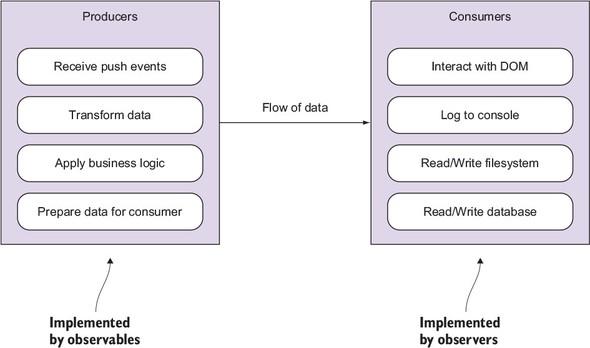
Let’s see what thinking in streams looks like more concretely in RxJS. In figure 1.9, we show a simple breakdown of a stream (or pipeline) approach to handling data. A pipeline is a series of logic blocks that will be executed, in order, when data becomes available.[4] On the left side of figure 1.9 are the data sources, which produce various forms of data to be consumed by an application. And on the right are the data consumers, the entities that subscribe to (or listen for) these events and will do something with data they receive, such as present it on a chart or save it to a file. In the middle is the data pipeline. During this middle step, data that’s coming from any of the data sources that are being observed is filtered and processed in different ways so that it can be more easily consumed by the consumers.
Declarative— Functional code has a peculiar style, which takes advantage of JavaScript’s higher-order functions to apply specialized business logic. As you’ll see later on, function chains (also known as pipelines) describe data transformation steps in an idiomatic manner. Most people see SQL syntax as a perfect example of declarative code.