concept redux in category rxjs

This is an excerpt from Manning's book RxJS in Action.
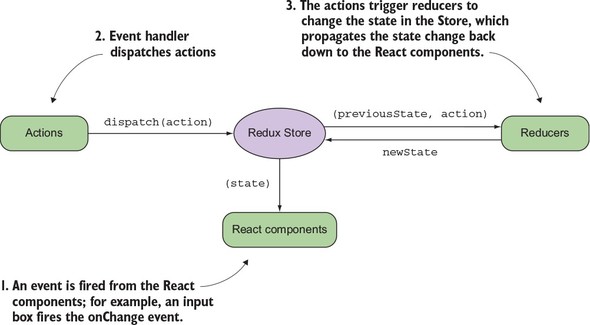
This store comes with the additional logic to break down actions and create a new state based on those actions. This means that instead of manually calling update-Accounts(), you now update accounts through the store using store.dispatch (action). Redux will manage invoking the proper reducer depending on the action. This goes back to our previous discussion about not making changes directly but using the frameworks to dispatch and manage such changes. Figure 10.9 shows this interaction.
A simple interaction between React and Redux, shown in figure 10.9, works in the following manner. The event originates from the React component and fires its event handlers, for instance, a button click or text box change. Then, the handler instantiates the corresponding action to take and uses Redux to dispatch the action, which in turn modifies the state in the centralized store. Lastly, this store gets propagated down to all React components, which then decide how best to react to this change.
You’ve rendered simple components on the page, so now you’ll move to your second stop on the roadmap, which is to use Redux to model your state management layer, the part of the system in charge of sharing data among your components. This section is a brief introduction to the pieces of Redux you’ll need to know.
Redux is a state container for JavaScript, and it takes care of how information flows through an application. Remember that state in RxJS is always transient, so for the purpose of temporarily retaining it, instead of creating mutable, global variables, Redux provides a read-only storage component.