concept Angular in category sails

This is an excerpt from Manning's book Sails.js in Action.
Whether you’re a frontend developer seeking to expand your backend knowledge or a server-side developer unfamiliar with using Node and JavaScript on the backend, the common denominator we all share is a desire to create web applications. Sails is designed to be compatible with whatever strategy you have for building your frontend, whether it be Angular, Backbone, iOS/Objective-C, Android/Java, or even a “headless” app that just offers up a raw API to be used by another web service or your developer community. Sails is great for building everyday backend apps that handle HTTP requests and WebSockets. It isn’t a good approach for building the client side of your application—that part is completely up to you. If you end up changing your approach (for example, switching from Backbone to Angular) or building a new frontend entirely (for example, building a Windows Phone native app), your Sails app will still work.
This chapter will help you answer those questions and explore in detail ways Sails can deliver frontend assets in a web application. Many great libraries and frameworks work well with Sails. We chose jQuery as a proxy for client-side DOM manipulation tools and Angular as a proxy for client-side frameworks. In this chapter, we’ll use both to demonstrate how to integrate DOM manipulation tools like jQuery and client-side JavaScript frameworks into the static asset pipeline. The remaining chapters will focus on Angular on the frontend.
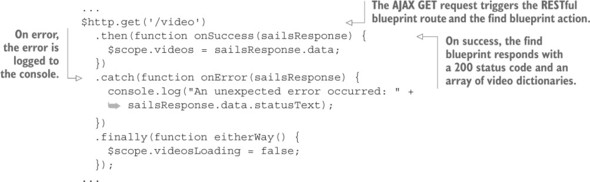
Because this book is primarily about the backend, we won’t be teaching you Angular, but we want to show a few examples to get you comfortable with integrating it with Sails.