concept browser in category scala

This is an excerpt from Manning's book Play for Scala: Covers Play 2.
Productivity starts with being able to make a code change, reload the web page in the browser, and see the result. This has always been the norm for many web developers, whereas Java web frameworks and application servers often have long build-redeploy cycles. Java hot-deployment solutions exist, but they aren’t standard and come at the cost of additional configuration. Although there’s more to productivity, this is what matters most.
Until recently, the web only supported one-way communication: a browser requests something from a server and the server can only send something in response to such a request. The server had no way of pushing data to a client other than as a response to a request.
For many applications, this is problematic. The classic example is a chat application, where anybody can send a new message, which the server then broadcasts to many clients. Without special tricks, this kind of broadcasting is impossible for a web application, because it’s an action that’s initiated from the server, and not from the browser.
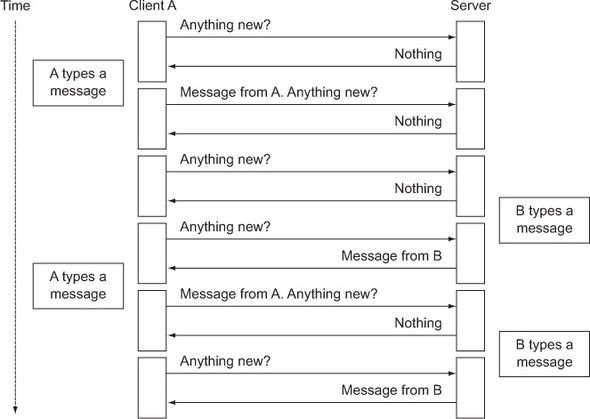
Various workarounds have been used in the past. The most basic approach is polling: the browser sends a request to the server to ask for new data every second or so. This is shown in figure 10.4.
When polling, the browser sends a request to the server at a regular interval requesting new messages. Often, the server will have nothing. When the browser wants to send data to the server, a new request is sent as well. In figure 10.4, we show the HTTP requests used between a client (Client A) and a server in a chat with a single other participant. As you can see, often a polling request is answered with no new message. A total of six requests are needed for this scenario with polling.

This is an excerpt from Manning's book Lift in Action: The Simply Functional Web Framework for Scala.
User behavior online in recent years has changed; people now spend more time than ever online, and this means they want the way they interact with online services to be more intuitive and natural. But building such rich applications has proven to be tough for many developers, and this often results in interfaces and infrastructures that aren’t really up to the job or user expectations. Lift aims to make building real-time, highly interactive, and massively scalable applications easier than it has ever been by supporting advanced features like Comet, which allow you to push data to the browser when it’s needed, without the user having to make any kind of request for it.
AJAX is increasingly well supported by the web programming ecosystem, but Comet, or server-push style programming, where data is dynamically sent to the browser without the user explicitly requesting it, has remained elusively difficult to implement for many developers. Lift provides powerful abstractions for both of these technologies.
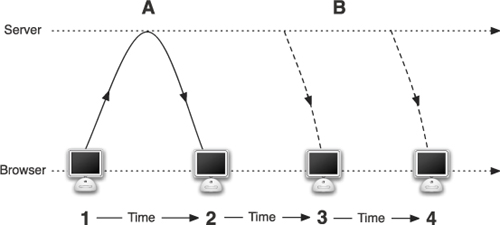
Consider figure 9.3, which illustrates the Comet request and response workflow. At time marker 1, the browser makes the initial request to the page that has the Comet component present. The server responds to the browser at time marker 2 and renders the page. But the server also keeps that initial request active using a technique called long polling. With the request still open, the server can then push data to the browser whenever it needs to, as illustrated at B.
To clarify that, take a look at the rendered code that reaches the browser:
<script type="text/javascript">
// <![CDATA[
alert("Important Alert Goes Here!");
// ]]>
</script>