concept html in category scala

This is an excerpt from Manning's book Play for Scala: Covers Play 2.
Web frameworks for web developers are different. They embrace HTTP and provide APIs that use HTTP’s features instead of trying to hide HTTP, in the same way that web developers build expertise in the standard web technologies—HTTP, HTML, CSS, and JavaScript—instead of avoiding them.
HTML document output matters: as Mark Pilgrim said (before he disappeared), “HTML is not just one output format among many; it is the format of our age.” This means that a web framework’s approach to formatting output is a critical design choice. View templates are a big deal; HTML templates in particular.
One approach minimizes the amount of HTML you write, usually by providing a user-interface component library. The idea is that you construct your user interface from UI “building blocks” instead of writing HTML by hand. This approach is popular with application developers who want a standard look and feel, or whose focus is more on the back end than the front end. Figure 3.11 illustrates this application architecture.
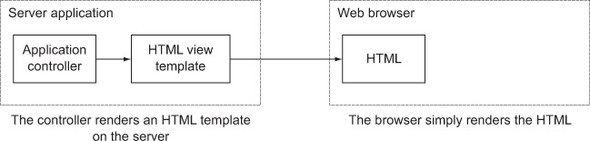
A different kind of template system works by decorating HTML to make content dynamic, usually with syntax that provides a combination of tags for things like control structures and iteration, and an expression language for outputting dynamic values. In one sense, this is a more low-level approach, because you construct your user interface’s HTML by hand, using HTML and HTTP features as a starting point for implementing user interaction. Figure 3.12 shows this approach’s architecture.
The most important implication of this approach is that there’s no generated HTML, no HTML that you don’t write by hand yourself. This means that not only can you choose how you write the HTML, but you can also choose which kind of HTML you use. At the time of writing, you should be using HTML5 to build web applications, but many UI frameworks are based on XHTML. HTML5 matters not just because it’s new, but because it’s the basis for a large ecosystem of JavaScript UI widgets.
Listing 7.3. Add Product form simplified HTML
@()

@main("Product Form"){

  <form action="@routes.Products.create()" method="post">
    <div>
      <label for="name">Product name</label>
      <input type="text" name="name" id="name">
    </div>
    <div>
      <label for="description">Description</label>
      <textarea id="description" name="description"></textarea>
    </div>
    <div>
      <label for="ean">EAN Code</label>

      <input type="text" name="ean" id="ean">
    </div>
    <div>
      <label for="pieces">Pieces</label>
      <input type="text" name="pieces" id="pieces">
    </div>
    <div>
      <label for="active">Active</label>
      <input type="checkbox" name="active" value="true">
    </div>
    <div class="buttons">
      <button type="submit">Create Product</button>
    </div>
  </form>
}