concept override in category scala

This is an excerpt from Manning's book Scala in Depth.
Scala did the world a great service when it introduced the override keyword. This keyword is used to demarcate when a method is intended to override vs. overload a method. If you neglect the keyword and the compiler finds you’re overriding a superclass method, it will emit an error. If you add the override keyword and no superclass has the defined method, the compiler will warn you. Thankfully, this is mostly enforced by the compiler. One scenario remains where override isn’t required but can cause issues: purely abstract methods. Scala has no abstract modifier: A purely abstract method is one that has no implementation.
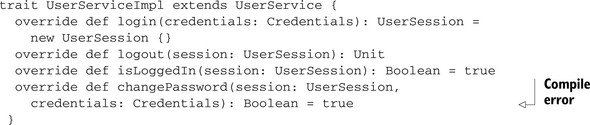
When we migrate UserServiceImpl to a trait, compilation now succeeds. This is an issue primarily when providing a library with no concrete implementations, or some form of DSL that’s expected to be extended. Therefore, only users of the library will notice this easy-to-prevent issue. All that’s required is to use the override modifier before any overridden method, as shown in the following listing:
Because this is such an easy error for the compiler to catch, there’s no reason to run into the issue. What about the multiple inheritance we mentioned earlier? It’s time to look into how override interacts with multiple inheritance.
Scala doesn’t require the override keyword when implementing abstract methods. This was done to help multiple inheritance. Let’s look at the classic “deadly diamond” inheritance problem. A deadly diamond occurs by creating a class that has two parent classes. Both of the parent classes must also be subclasses of the same parent-parent class. If you were to draw a picture of the inheritance relationship, you would see a diamond.
Let’s start our own diamond by creating two traits, Cat and Dog, that extend a common base trait Animal. The Animal trait defines a method talk that’s also defined in Cat and Dog. Now imagine some mad scientist is attempting to combine cats and dogs to create some new species, the KittyDoggy. How well could they do this using the override keyword? Let’s define our three classes in the following listing and find out: