concept transaction in category scala

This is an excerpt from Manning's book Play for Scala: Covers Play 2.
HTTP is an internet protocol whose beauty is in its simplicity, which has been a key factor in its success. The protocol is structured into transactions that consist of a request and a response, each of which is text-based, as figure 3.2 shows. HTTP requests use a small set of commands called HTTP methods, and HTTP responses are characterized by a small set of numeric status codes. The simplicity also comes from the request-response transactions being stateless.
If you look up the source code for Query (the return type of our query methods), you’ll see that it also extends Iterable. This might suggest that you can just loop over the query or otherwise extract its contents to get at the results. Well... yes, but not yet. Our Iterable doesn’t actually contain the results yet, but it will retrieve them for you as soon as you try to access its content (by looping over it, for example). Without a database connection available, this will fail with an exception, but we can provide our query with a connection by wrapping our code in a transaction.
In Squeryl lingo, a transaction is just a database context: a collection of a database connection and a database transaction (something you can commit or roll back) and any other bookkeeping that Squeryl needs to keep track of. This will provide our query with a context to run in, which makes the right kind of variables available for it to be able to talk to our database.
transaction {
  product.stockItems.associate(stockItem)
  warehouse.stockItems.associate(stockItem)
}
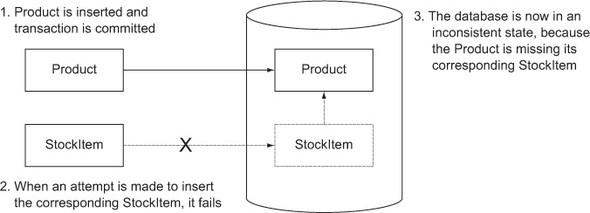
In order to ensure your database’s data integrity, you’ll want to use transactions. Databases that provide transactions guarantee that all write operations in the same transaction will either succeed together or fail together. For example, this protects you from having a Product without its StockItem in your database when you were trying to insert both. Figure 5.6 illustrates the problem.
Squeryl provides two methods for working with transactions: transaction and inTransaction. Both of these make sure that the code block they wrap is in a transaction. The difference is that transaction always makes its own transaction and inTransaction only makes a transaction (and eventually commits) if it’s not already in a transaction. This means that because our DAO methods wrap everything in an inTransaction, they themselves can be wrapped in a transaction and succeed or fail together and never separately.