concept attacker in category security

This is an excerpt from Manning's book The Art of Network Penetration Testing.
A threat actor is a fancy way of saying attacker. Anyone attempting to do harm to an organizations information technology assets.
During an INPT, you assume that the attacker was able to successfully gain physical entry into a corporate office or perhaps was able to obtain remote access to an employee’s workstation through email phishing. It is also possible that the attacker visited an office after-hours, posing as a custodial worker, or during the day, posing as a vendor or flower delivery person. Maybe the attacker is an actual employee and just used a badge to walk into the front door.
There are countless ways to gain physical entry into a business, which can be easily demonstrated. For many businesses, an attacker simply needs to walk through the main entrance, smile politely at anyone that passes by while wandering around appearing to have a purpose or talking on a cell phone until they identify an unused area to plug into a data port. Professional companies offering high-caliber penetration testing services typically bill by the hour, anywhere from $150.00 to $500.00 per hour. As a result, it’s often cheaper for the client purchasing the penetration test to skip this part and place the attacker on the internal subnet from the beginning.
Either way the attacker has managed to get access to the internal network; now what can she do? What can she see? A typical engagement assumes that she knows nothing about the internal network and has no special access or credentials. All she has is access to the network, and coincidentally, that’s usually all she needs.
The attackers typically obtain a map or schematic of the target and spend a lot of time analyzing all of the different ways into the building. These are usually doors, windows, parking garages, elevator and ventilation shafts, you name it. From an attacker’s perspective you can call these entry points or attack surfaces and that’s exactly what network services are. The entry points into our target network. The surfaces that you will attack in an attempt to gain unauthorized entry into restricted areas of the network.

This is an excerpt from Manning's book API Security in Action.
There are also physical assets to consider such as the physical servers or devices that your API is running on. For servers running in a datacenter, there are relatively few risks of an intruder stealing or damaging the hardware itself, due to physical protections (fences, walls, locks, surveillance cameras, and so on) and the vetting and monitoring of staff that work in those environments. But an attacker may be able to gain control of the resources that the hardware provides through weaknesses in the operating system or software running on it. If they can install their own software, they may be able to use your hardware to perform their own actions and stop your legitimate software from functioning correctly.
In short, anything connected with your system that has value to somebody should be considered an asset. Put another way, if anybody would suffer real or perceived harm if some part of the system was compromised, that part should be considered an asset to be protected. That harm may be direct, such as loss of money, or it may be more abstract, such as loss of reputation. For example, if you do not properly protect your users’ passwords and they are stolen by an attacker, the users may suffer direct harm due to the compromise of their individual accounts, but your organization would also suffer reputational damage if it became known that you had not followed basic security precautions.
There are examples of injection vulnerabilities that do not involve code being executed at all. For example, HTTP headers are lines of text separated by carriage return and new line characters ( "\r\n"
in Java). If you include unvalidated user input in a HTTP header then an attacker may be able to add a "\r\n" character sequence and then inject their own HTTP headers into the response. The same can happen when you include user-controlled data in debug or audit log messages (see chapter 3), allowing an attacker to inject fake log messages into the log file to confuse somebody later attempting to investigate an attack.
Using a minimal base image such as the Alpine distribution or Google’s distroless images reduces the attack surface of potentially vulnerable software and limits further attacks that can be carried out if the container is ever compromised. In this case, an attacker would be quite happy to find curl on a compromised container, but this is missing from the distroless image as is almost anything else they could use to further an attack. Using a minimal image also reduces the frequency with which you’ll need to apply security updates to patch known vulnerabilities in the distribution because the vulnerable components are not present.
A server-side request forgery attack occurs when an attacker can submit URLs to an API that are then loaded from inside a trusted network. By submitting URLs that refer to internal IP addresses the attacker may be able to discover what services are running inside the network or even to cause side-effects.
Figure 10.4 In a server-side request forgery (SSRF) attack, the attacker sends a URL to a vulnerable API that refers to an internal service. If the API doesn’t validate the URL it will make a request to the internal service that the attacker couldn’t make themselves. This may allow the attacker to probe internal services for vulnerabilities, steal credentials returned from these endpoints, or directly cause actions via vulnerable APIs.
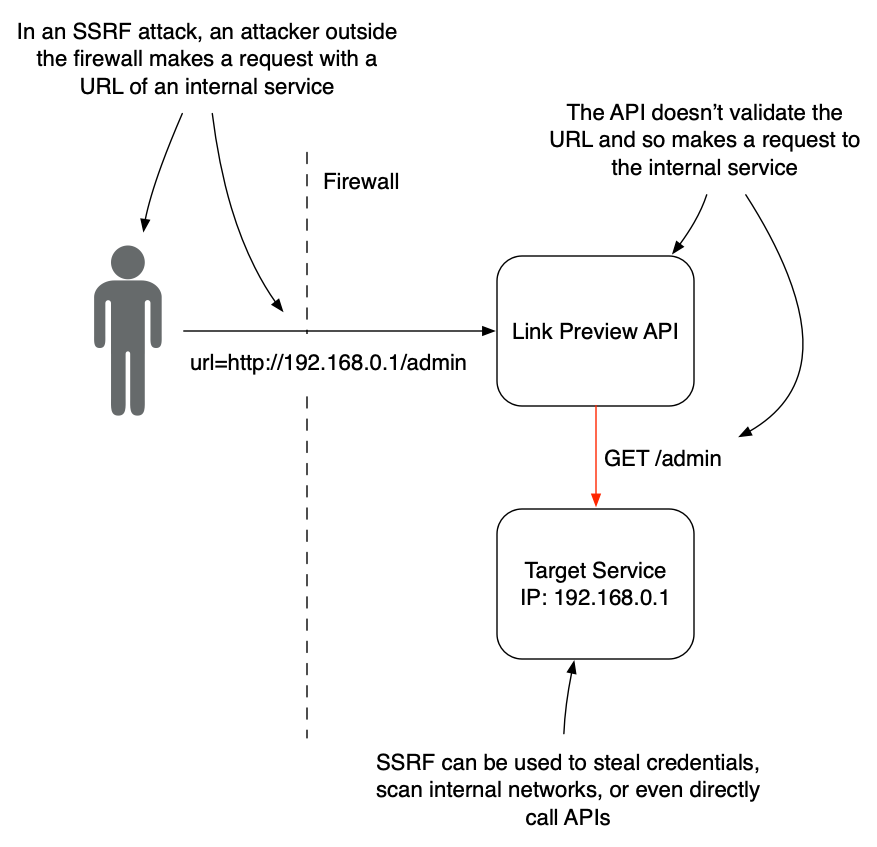
SSRF attacks can be devastating in some cases. For example, in July 2019, Capital One, a large financial services company, announced a data breach that compromised user details, social security numbers, and bank account numbers (https://www.capitalone.com/about/newsroom/capital-one-announces-data-security-incident/). Analysis of the attack (https://ejj.io/blog/capital-one) showed that the attacker exploited a SSRF vulnerability in a Web Application Firewall to extract credentials from the AWS metadata service, which is exposed as a simple HTTP server available on the local network. These credentials were then used to access secure storage buckets containing the user data.

This is an excerpt from Manning's book API Security Starter.
There are also physical assets to consider such as the physical servers or devices that your API is running on. For servers running in a datacenter, there are relatively few risks of an intruder stealing or damaging the hardware itself, due to physical protections (fences, walls, locks, surveillance cameras, and so on) and the vetting and monitoring of staff that work in those environments. But an attacker may be able to gain control of the resources that the hardware provides through weaknesses in the operating system or software running on it. If they can install their own software, they may be able to use your hardware to perform their own actions and stop your legitimate software from functioning correctly.
In short, anything connected with your system that has value to somebody should be considered an asset. Put another way, if anybody would suffer real or perceived harm if some part of the system was compromised, that part should be considered an asset to be protected. That harm may be direct, such as loss of money, or it may be more abstract, such as loss of reputation. For example, if you do not properly protect your users’ passwords and they are stolen by an attacker, the users may suffer direct harm due to the compromise of their individual accounts, but your organization would also suffer reputational damage if it became known that you had not followed basic security precautions.
There are examples of injection vulnerabilities that do not involve code being executed at all. For example, HTTP headers are lines of text separated by carriage return and new line characters ("\r\n" in Java). If you include unvalidated user input in a HTTP header then an attacker may be able to add a "\r\n" character sequence and then inject their own HTTP headers into the response. The same can happen when you include user-controlled data into debug or audit log messages (see chapter 3), allowing an attacker to inject fake log messages into the log file to confuse somebody later attempting to investigate an attack.
Figure 2.8 A reflected cross-site scripting (XSS) attack against your API can occur when an attacker gets a web browser client to submit a form with carefully crafted input fields. When submitted, the form looks like valid JSON to the API, which parses it but then produces an error message. Because the response is incorrectly returned with a HTML content-type, the malicious script that the attacker provided is executed by the web browser client.
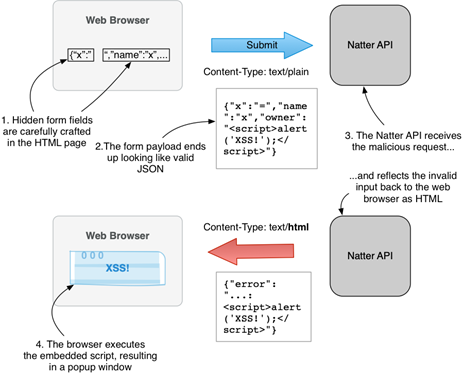
Developers sometimes assume that if they produce valid JSON output then XSS is not a threat to a REST API. In this case, the API both consumed and produced value JSON and yet it was possible for an attacker to exploit an XSS vulnerability anyway.

This is an excerpt from Manning's book Secure by Design.
If you take a look at this representation of a user, you can see that there are possible security issues in this code. One issue is that because you’re accepting any string value as a username, the username could be used for performing XSS attacks. An XSS attack occurs when an attacker uses a web application to send malicious code to a different user. The malicious code could, for example, be in the form of client-side JavaScript. If the attacker enters something like
<script>alert(42);</script>as the username when registering for the service, later, when the user’s username is displayed on some web page in the application, it could lead to an alert box being displayed in the browser showing the number 42.11
As developers, we’re constantly reminded about priorities and deadlines. Cutting corners and dirty hacks are sometimes part of reality that we must accept—or are they? The truth is, at the end of the day, you decide what syntax to use, what algorithms to apply, and how to steer the flow of execution. If you truly understand why certain code constructs are better than others, then using them becomes second nature and no more time-consuming than writing bad code. The same applies to security. Attackers don’t care about deadlines or priorities—a weak system is exploitable, regardless of why or under what circumstances it was built.