concept service mesh in category security

This is an excerpt from Manning's book API Security in Action.
A service mesh is a set of components that secure communications between pods in a cluster using proxy sidecar containers. In addition to security benefits, a service mesh provides other useful functions such as load balancing, monitoring, logging, and automatic request retries.
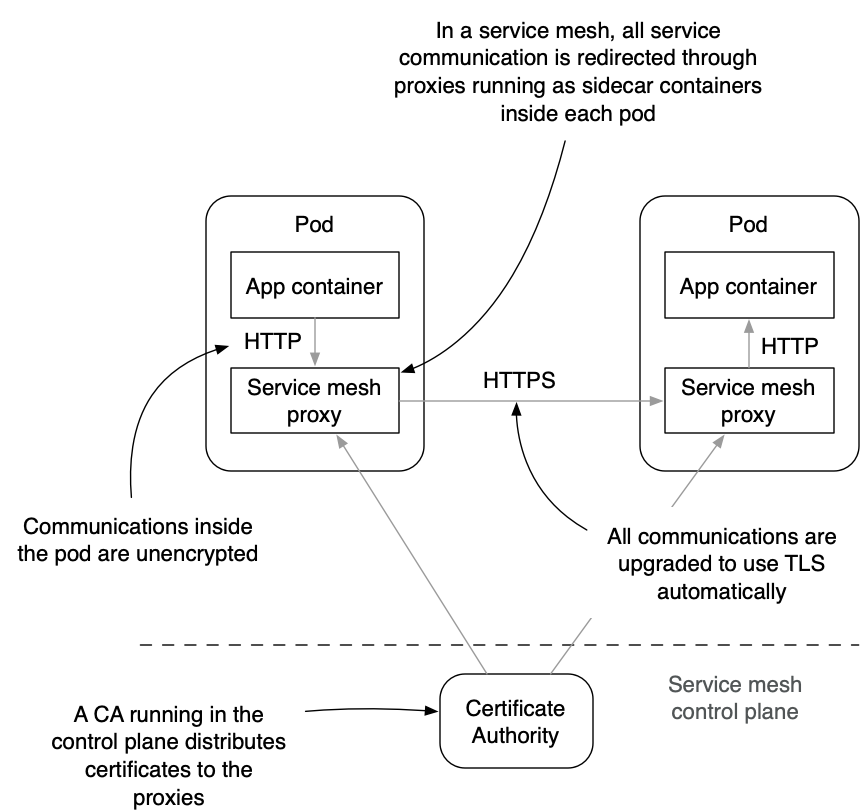
A service mesh works by installing lightweight proxies as sidecar containers into every pod in your network, as shown in figure 10.6. These proxies intercept all network requests coming into the pod (acting as a reverse proxy) and all requests going out of the pod. Because all communications flow through the proxies they can transparently initiate and terminate TLS, ensuring that communications across the network are secure while the individual microservices use normal unencrypted messages. For example, a client can make a normal HTTP request to a REST API and the client’s service-mesh proxy (running inside the same pod on the same machine) will transparently upgrade this to HTTPS. The proxy at the receiver will handle the TLS connection and forward on the plain HTTP request to the target service. To make this work, the service mesh runs a central CA service that distributes certificates to the proxies. Because the service mesh is aware of Kubernetes service metadata, it automatically generates correct certificates for each service and can periodically reissue them[2].
Figure 10.6 In a service mesh a proxy is injected into each pod as a sidecar container. All requests to and from the other containers in the pod are redirected through the proxy. The proxy upgrades communications to use TLS using certificates it obtains from a CA running in the service-mesh control plane.
To enable a service mesh, you need to install the service-mesh control plane components such as the CA into your cluster. Typically, these will run in their own Kubernetes namespace. In many cases, enabling TLS is then simply a case of adding some annotations to the deployment YAML files. The service mesh will then automatically inject the proxy sidecar container when your pods are started and configure them with TLS certificates.