concept token - base authentication in category security

This is an excerpt from Manning's book API Security in Action.
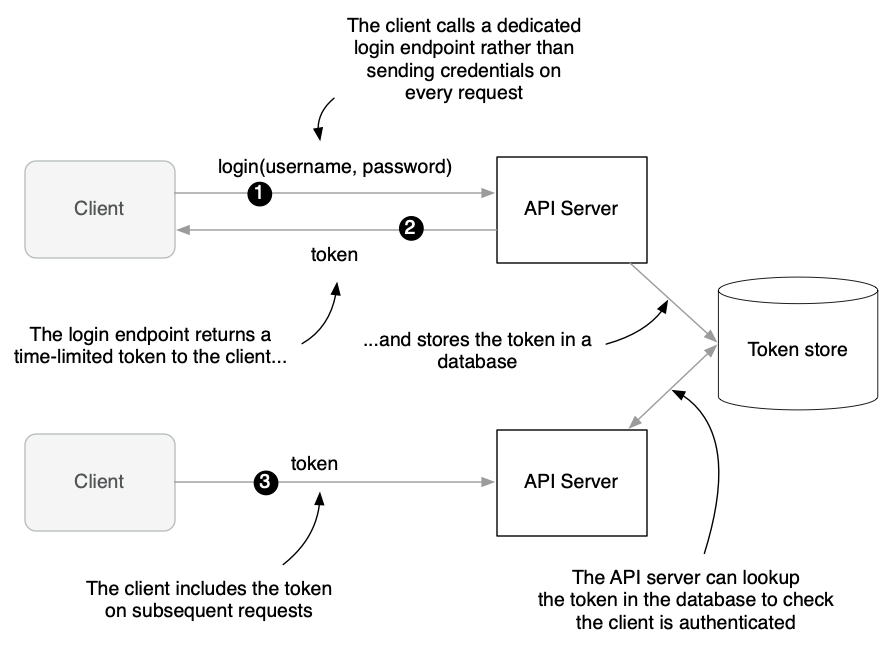
So far, you have required API clients to submit a username and password on every API request to enforce authentication. Although simple, this approach has several downsides from both a security and usability point of view. In this chapter, you’ll learn about those downsides and implement an alternative known as token-based authentication, where the username and password are supplied once to a dedicated login endpoint. A time-limited token is then issued to the client that can be used in place of the user’s credentials for subsequent API calls. You will extend the Natter API with a login endpoint and simple session cookies and learn how to protect those against cross-site request forgery (CSRF) and other attacks. The focus of this chapter is authentication of browser-based clients hosted on the same site as the API. Chapter 5 covers techniques for clients on other domains and non-browser clients such as mobile apps.
Figure 4.4 In token-based authentication the client first makes a request to a dedicated login endpoint with the user’s credentials. In response, the login endpoint returns a time-limited token. The client then sends that token on requests to other API endpoints that use it to authenticate the user. API endpoints can validate the token by looking it up in the token database.