concept url in category security

This is an excerpt from Manning's book API Security in Action.
The
spaceIdis a numeric value that is created by your application from a sequence, so that is relatively safe, but the other two variables come directly from the user. In this case, the input comes from the JSON payload, but it could equally come from query parameters in the URL itself. All types of requests are potentially vulnerable to injection attacks, not just POST methods that include a payload.
An implementation of the microservice is shown in listing 10.9. The API exposes a single operation, implemented as a GET request to the
/previewendpoint with the URL from the link as a query parameter. You can use jsoup to fetch the URL and parse the HTML that is returned. Jsoup does a good job of ensuring the URL is a valid HTTP or HTTPS URL, so you can skip performing those checks yourself and instead register Spark exception handlers to return an appropriate response if the URL is invalid or cannot be fetched for any reason.
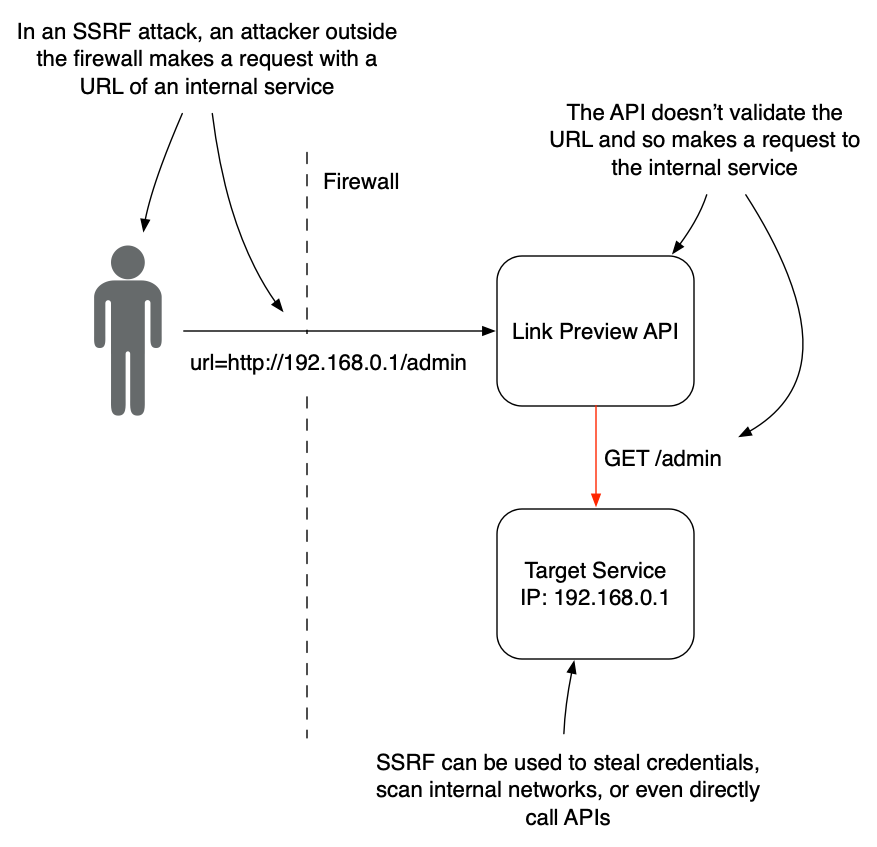
A server-side request forgery attack occurs when an attacker can submit URLs to an API that are then loaded from inside a trusted network. By submitting URLs that refer to internal IP addresses the attacker may be able to discover what services are running inside the network or even to cause side-effects.
Figure 10.4 In a server-side request forgery (SSRF) attack, the attacker sends a URL to a vulnerable API that refers to an internal service. If the API doesn’t validate the URL it will make a request to the internal service that the attacker couldn’t make themselves. This may allow the attacker to probe internal services for vulnerabilities, steal credentials returned from these endpoints, or directly cause actions via vulnerable APIs.