concept entity in category sharePoint
appears as: An entity, entity, entity, entities, entities, n entity
This is an excerpt from Manning's book SharePoint 2007: Developer’s Guide to Business Data Catalog.
Entity —Each LobSystemInstance contains one or more entities. An entity represents the data returned, for example, customers or overdue orders. Each row in the entity is known as an entity instance. Each entity also contains methods, actions, and identifiers.
Version —The version here is important, especially if you’re already using the BDC in a live system and want to make changes to it. Functionality such as the BDC Web Parts and the Business Data column will always utilize the latest application definition version, so if you want to make changes to a LOB system that’s already being used, simply increase the version number and reimport. If you do this, ensure your latest version has all of the entities you’d originally defined; otherwise you may find that web parts that were already consuming BDC data could stop working.
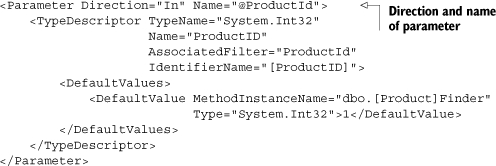
Listing 2.10. An example output parameter for an entity
<Parameter Direction="Return" Name="dbo.Product"> <TypeDescriptor TypeName="System.Data.IDataReader, System.Data, Version=2.0.3600.0, Culture=neutral, PublicKeyToken=b77a5c561934e089" IsCollection="true" Name="dbo.ProductDataReader"> <TypeDescriptors> <TypeDescriptor TypeName="System.Data.IDataRecord, System.Data, Version=2.0.3600.0, Culture=neutral, PublicKeyToken=b77a5c561934e089" Name="dbo.ProductDataRecord"> <!-- Listing 2.11 goes here --> </TypeDescriptor> </TypeDescriptors> </TypeDescriptor> </Parameter>