concept CallMethodAction in category silverlight

This is an excerpt from Manning's book Silverlight 5 in Action.
Properties are one of the pieces that define an object’s interface. Because XAML (without the addition of something like the CallMethodAction behavior, discussed in chapter 33) doesn’t allow you to do anything specifically with methods, the only other part of the interface left is the definition of events.
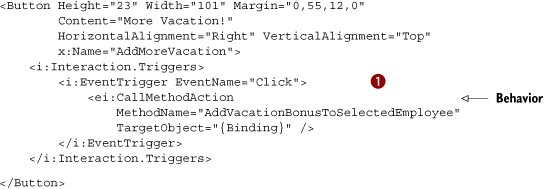
Introduced with Expression Blend 4, the CallMethodAction behavior provides an easy and designer-friendly way to wire any event from any control to a method. In some ways, it’s an alternative to using ICommand and may even seem redundant. But many applications will use both approaches due to the usefulness of ICommand with buttons and menus and CallMethodAction’s support for other controls, and events other than Click.

This is an excerpt from Manning's book Silverlight 4 in Action: Silverlight 4, MVVM, and WCF RIA Services.
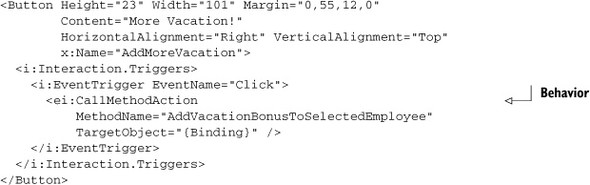
In this section, we’ll look at two ways you can have elements in XAML invoke methods in the ViewModel. The first approach, ICommand, is the traditional way initially introduced in WPF and supported in most MVVM toolkits. The second, the CallMethodAction behavior, is a new approach introduced with Expression Blend 4.