concept agent in category software development

This is an excerpt from Manning's book Event Processing in Action.
We represent each agent definition element as a rounded square box containing one or more named input terminals which can receive events from other entities, and one or more output terminals, through which it emits events. The number of terminals varies depending on the kind of agent it is.
The input and output terminals can be labeled with a set of event types to show what they are prepared to receive (input terminals) and what they are able to emit (output terminals). In addition, input terminals can be assigned filter conditions, which restrict the set of event instances that will be accepted by the agent. A purist might argue that the ability to specify a filter is not strictly needed, because one could achieve the same effect by inserting an explicit filter agent upstream from the agent in question. The reason for including a filter in the specification of the agent is that the logic of the agent proper might be dependent on the filter, and it therefore makes sense for the processing logic and the filter to be specified in a single entity.
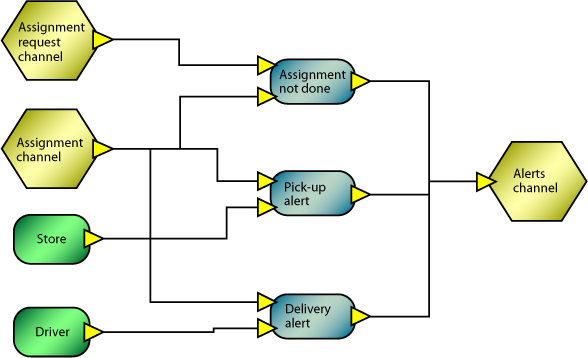
This section copies section 6.2.7 showing the event processing network for the Fast Flower Delivery application. For simplicity, each of the different parts of the network is shown in a different illustration. Please note that where these illustrations include explicit channels, they only show the connections from these channels to other entities in the figure concerned. For example, in figure B.3 you can see that the Bid Request channel receives events from the Bid Request creator agent, but to see what happens to them you’ll need to look at figure B.5 where you’ll see that this same channel delivers events to agents in the assignment system.