concept ALM in category software development

This is an excerpt from Manning's book Agile ALM: Lightweight tools and Agile strategies.
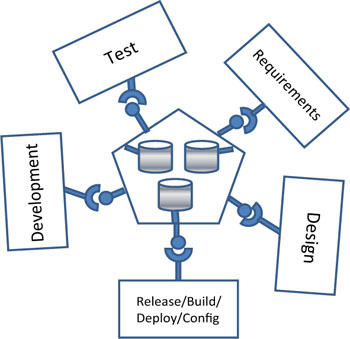
ALM is aligned with the engineering process, spanning development phases. This results in releases that are functionally and technically consistent. ALM also manages the relationships between various artifact types, including requirement documents, coding artifacts, and build scripts that are used or produced by the engineering process. By organizing, linking, and referencing activities and artifacts, you can track the development progress as a whole. Through the use of integrated toolchains, ALM helps you to overcome the biggest challenge in the software creation process: the technological and functional barriers that make it difficult to implement a transparent and consistent development process.
Figure 1.5. ALM is an implicit, pluggable hub: barrier-free engineering without redundant activities or redundant data. We now have neither orthogonal (as in figure 1.3) nor fragmented ALM aspects (as in figure 1.4).