concept consumer in category software development

This is an excerpt from Manning's book Agile Metrics in Action: How to measure and improve team performance.
One of the strengths of agile development methods is the idea that you are delivering a living product, not completing a project. A project is a defined set of time within which something is developed and tracked; a product is a living thing that continues to change to meet the needs of the consumer. This is shown in figure 1.2.
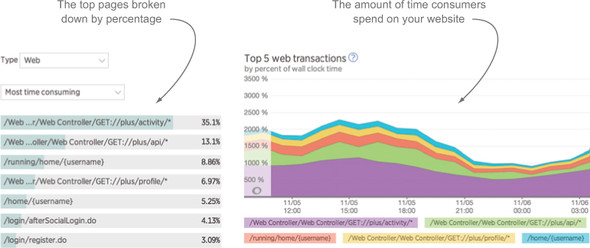
Data from your production systems mainly produces reactive metrics. Your release cycle is behind you; you thought your code was good enough for the consumer and you put it out there. Now you have to watch to make sure you understand how it’s working and if the changes you made are good—or not. Your sponsor will also likely care how well the features you’re delivering are serving the consumer.
For every new feature they were going to implement they asked, “What is the value to the consumer of this change, how do we measure it, and how does it affect conversion?” The next tweak the development team made was to add a More Info button that had a Buy Now button on it. The feature was designed with the following theories in mind:
They wanted to show many products on the page to a consumer at once, so they would save space by showing info in a pop-up instead of inline. They thought that with that info consumers would be more likely to buy a product and therefore should click the Buy Now button from that pop-up.

This is an excerpt from Manning's book Event Processing in Action.
Observation— Event processing is used to monitor a system or process by looking for exceptional behavior and generating alerts when such behavior occurs. In such cases the reaction, if any, is left to the consumers of the alerts; the job of the event processing application is to produce the alerts only. The patient monitoring system (example 1) comes under this heading, as does the luggage monitoring system (example 2) and the safety regulation compliance system (example 3).
In chapter 4 we saw that the designer of an event producer has to choose a strategy for when it produces an event. We don���t have to worry about such complexities when it comes to event consumers. An event consumer interacts in pretty much the same way as any other node within an EPN. Its input terminals identify, by means of filters, the set of event types and instances that the consumer is prepared to accept.
The complications that occur with event consumers arise from the fact that an event consumer definition element can (and often does) represent a class of multiple concrete consumer instances (we refer to them as members of the class). The first complication is that the members of the class may change over time (in other words, the class could be dynamic). This is particularly likely to happen if the consumer provides a visualization interface, as there could be a new concrete consumer each time a new user opens the visualization application. In such cases the system has to provide a dynamic registration interface, allowing concrete consumer instances to be registered or deregistered. We refer to the act of registering a consumer instance as subscribing, and the act of deregistering as unsubscribing. The entity that submits the subscribe request is called a subscriber. In many cases it is the would-be consumer instance that submits the subscribe request (the subscriber and consumer are one and the same), but there are cases where one entity can request a subscription on behalf of another.
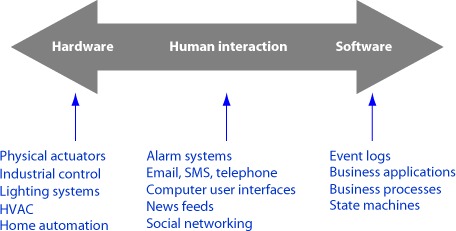
People can be alerted to important and urgent events by alarm systems (for example, bells or flashing lights) or by system-generated telephone calls. For less urgent alerts, you could use a consumer that generates an email or a Short Message Service (SMS) text message.
Consumers frequently convey information about events through the medium of a computer user interface. This interface is implemented either by a specially written client application or, increasingly frequently, via a web application that allows the event data to be viewed on a web browser without requiring the installation of specialist software.