concept customer in category software development

This is an excerpt from Manning's book Kanban in Action.
He explained that the aim of the game is for each station to flip all coins once and then pass them on. When all workers have flipped all coins, they’re done and delivered to the customer. Everyone seemed to be with him so far.
Another way of expressing this is to ask, “What’s stopping the work from flowing?” Applying this perspective, you examine your processes from the customer’s point of view. What does the customer want from this process? The customer can be the end customer or the internal customer in the next phase of production. What the customer wants has value. Everything else is waste. Some steps in a process add value, others don’t. This is true for all processes.

This is an excerpt from Manning's book Specification by Example: How Successful Teams Deliver the Right Software.
Generally, frequent releases promote quick feedback, enabling development teams to find mistakes and fix them sooner. But iterating quickly doesn’t prevent mistakes. Often, teams take three or four stabs at implementing a feature; developers claim this is because customers don’t know what they want until they get something to play with. I disagree. With Specification by Example, teams generally hit the target in the first attempt. This saves a lot of time and makes the delivery process more predictable and reliable.
Marta Gonzalez Ferrero was working as a test lead at Beazley when they introduced Specification by Example. According to her, the development team was committing to more work than they could produce, and they often realized they needed a lot more information than they were getting at the start of the implementation. The situation was further complicated by the fact that they were running six-week iterations, and the development team and the business analysts were on different continents. The acceptance criteria that the programmers were receiving from the business analysts was relatively abstract (for example, “make sure that for this business unit all correct products are displayed”). Finding out that something important was missing halfway through an iteration would seriously disrupt the output. One iteration ended with customers saying that the team delivered something completely different from what was expected. The last week of each iteration was reserved for the model office: effectively, an iteration demonstration. Ferrero traveled to the United States for one model office and worked with business analysts on illustrating requirements with examples for two days. As a result, the team committed to 20% less work for the next iteration and delivered what they promised.
Teams that sell enterprise software to several customers rarely have the luxury of involving customer representatives in collaborative specification workshops. Product managers collect requirements from different customers and decide on release plans. This introduces the possibility of ambiguity and misunderstanding. We can have perfectly precise and clear examples that don’t capture what the customers want.


This is an excerpt from Manning's book Becoming Agile ...in an imperfect world.
Working software is the primary measure of progress. If you recall, the customer is primarily interested in working software. So why would you measure progress in terms of anything else? Today, the progress of most software development efforts is measured in terms of their plan. When requirements are complete, the managers say the project is 30 percent complete. In a plan-driven world, this may be correct; but in a value-driven world, where the value is the working software, the project is 30 percent complete when 30 percent of the required functionality is coded, integrated, tested, and deployed. This is a fundamental difference between the agile value-driven world and the traditional plan-driven world.
Team members grab blank index cards and enter the information from the Feature Description Document (explained in chapter 11) and additional information gathered from the customer. Acme Media gathered this information in chapter 11 when Jay, the product manager, introduced the project team to the project’s features.
At this point, your feature cards are born, but they aren’t complete. Figure 12.2 displays a feature card for the Auctionator after the initial conversation with the customer.
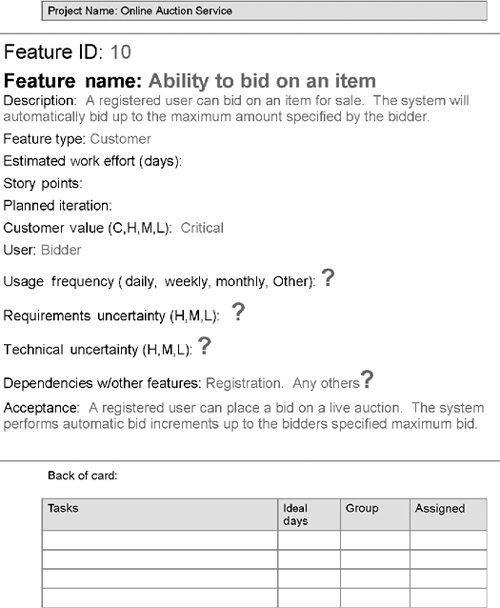
A functional specification focuses on delivering what was requested at the beginning. In our experience, what the customer wants changes as they see the product demonstrated. Feature cards begin the process of identifying what is needed at the end, not the beginning. A functional specification can position the customer as an enemy, with definitive statements such as the system shall. The customer is also somewhat inhuman when their needs are presented on paper versus via a face-to-face conversation.
Once we worked on an intranet platform that had multiple customers per release. Some customers were available for the feature-card exercise, and others had only an hour or two to give. Some customers were totally unavailable due to vacation or illness. If a customer had only an hour or two, we interviewed them intensely for the time they were available and then used a proxy to continue the process. The proxy was frequently a business analyst who spent time with the customer before the feature card meeting. As the feature-card discussions continued without the customer, the analyst provided feature requirements and decisions; later, they reviewed the discussion with the real customer.
In cases where the customer wasn’t available at all, we debriefed them before the session and had someone on our team named as a proxy in advance of the meeting.

This is an excerpt from Manning's book Test Driven: Practical TDD and Acceptance TDD for Java Developers.
The ability of the customer to decide what their money is spent on can really change the way they look at software projects. Finally, the customer is in control of what their money is spent on. Talk about motivating the customer!
These user stories express just enough for the customer to be able to prioritize the feature in relation to other features and for the developer to be able to come up with a rough effort estimate for the story. Yet these stories don’t burden the developer by prescribing the implementation, and they don’t drown the team with excessive detail.
The first story about a technical-support application doesn’t tell us what the screen will look like; and the second story doesn’t talk about desktop shortcuts, scanning process listings, and so on. They convey what provides value to the customer—not how the system should provide that value. The third story is a bit different. It’s clearly a technical user story, not having much to do with business functionality. It does, however, have enabling value, and it expresses that need in a clear manner. Furthermore, although harder to quantify, some technical stories might create value for the customer through lower total cost of ownership.
Even though the customer should be the one who owns the acceptance tests, they don’t need to be the only one to write them. Especially when we’re new to user stories and acceptance tests, it is important to provide help and support so that nobody ends up isolating themselves from the process due to lack of understanding and, thus, being uncomfortable with the tools and techniques. By writing tests together, we can encourage the communication that inevitably happens when the customer and developer work together to specify the acceptance criteria for a story.
With the customer in their role as domain expert, the developer in the role of a technical expert, and the tester in a role that combines a bit of both, we’ve got everything covered. Of course, there are times when the customer will write stories and acceptance tests by themselves—perhaps because they were having a meeting offsite or because they didn’t have time for a discussion about the stories and their accompanying tests.
The same goes for a developer or tester who occasionally has to write acceptance tests without access to the customer. On these occasions, we’ll have to make sure that the necessary conversation happens at some point. It’s not the end of the world if a story goes into the backlog with a test that’s not ideal. We’ll notice the problem and deal with it eventually. That’s the beauty of a simple requirement format like user stories!
Another essential property for good acceptance tests ties in closely with the customer being the one who’s writing the tests: the focus and perspective from which the tests are written.
One of the key characteristics that make user stories so fitting for delivering value early and often is that they focus on describing the source of value to the customer instead of the mechanics of how that value is delivered. User stories strive to convey the needs and wants—the what and why—and give the implementation—the how—little attention. In the vast majority of cases, the customer doesn’t care how the business value is derived.[3]
3 Well, they shouldn’t. Part of the reason many customers like to dictate the how is our lousy track record as an industry. It’s time to change that flawed perception by showing that we can deliver what the customer wants as long as we get constant feedback on how we’re doing.
Let’s look at an example to better illustrate this difference between what and why and how. Figure 9.3 shows an example of acceptance tests that go into too much detail about the solution rather than focusing on the problem—the customer’s need and requirement. All three tests shown on the card address the user interface—effectively suggesting an implementation, which isn’t what we want. While doing that, they’re also hiding the real information—“what are we actually testing here?”—behind the technology.
Instead, we should try to formulate our tests in terms of the problem and leave the solution up to the developers and the customer to decide and discuss at a later time when we’re implementing the tests and the story itself. Figure 9.4 illustrates a possible rewrite of the tests in figure 9.3 in a way that preserves the valuable information and omits the unnecessary details, which only clutter our intent.
