concept datum in category software development

This is an excerpt from Manning's book Agile Metrics in Action: How to measure and improve team performance.
Your team is generating a lot of data throughout your entire software development lifecycle (SDLC). Figure 1.4 shows the components that are typically used by an agile software delivery team.
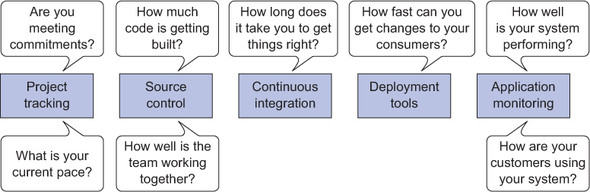

This is an excerpt from Manning's book Specification by Example: How Successful Teams Deliver the Right Software.
The team used slimmed-down use cases (they called them “structured stories”) so that initial capture and ongoing evolution wasn’t a big problem. Those use cases would avoid most details about data and decisions (these were extracted into separate data sections). Vogel explained that approach:
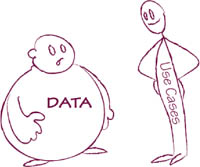
“In a use case you would have a nickname for a piece of data, something that the customer understands as part of the domain language. The data section describing that gives the structure and the rules describing the data—not examples. Examples are in the [acceptance] tests/requirements-by-example where we walk the use case building examples that cover and show variations of all our named chunks of data. You vary your examples of the chunks of data that they have factored out.”
With complex heterogeneous systems, it might be hard or even impossible to include the entire end-to-end flow in an automated test. When I interviewed Rob Park, his team was working on an integration with an external system that converts voice to data. Going through the entire flow for every automated case would be impractical, if not impossible. But they weren’t developing voice recognition, just integrating with such a system.

Their responsibilities are in the context of what happens to voice messages after they get converted to data. Park says that they decided to isolate the system and provide an alternative input path to make it easier to automate:
“Now we’re writing a feature for Interactive Voice Response. Policy numbers and identification get automatically transferred to the application from an IVR system, so the screens come up prepopulated. After the first Three Amigos conversation, it became obvious to have a test page that prepares the data sent by the IVR.”
When executable specifications are automated to use a database, the data in the database becomes part of the automation context. Instead of automating how the contextual information is put into the database before a test, some teams reused existing data that suits the purpose. This makes it easier to automate the specifications but makes them harder to understand. Anyone who reads such specifications has to also understand the data in the database. Channing Walton advises against this:
“Setting up databases by prepopulating a standard baseline data set almost always causes a lot of pain. It becomes hard to understand what the data is, why it is there, and what it is being used for. When tests fail, it’s hard to know why. As the data is shared, tests influence each other. People get confused very quickly. This is a premature optimization. Write tests to be data agnostic.”

This is an excerpt from Manning's book Test Driven: Practical TDD and Acceptance TDD for Java Developers.
TDD and acceptance TDD don’t make us type any faster, but they help us cut time from less productive activities such as debugging and cursing at unreadable code, or rework due to misunderstandings regarding requirements. As we proceed in small steps, accumulating tests and becoming more confident about our code, we no longer feel the need to repeat the same tests over and over again “just in case the computer would do something different this time,” or feel unsure whether we’ve checked that odd combination of data that could break things.
Data is everywhere. Think about it. How many systems have you worked with in your professional career where the business logic you implemented did not operate on persistent data? Exceptions do exist, of course, but the majority of systems in today’s enterprises deal with persistent data—and with lots of it. As such, data has a central role in the development of these systems and in the day-to-day lives of software developers. Furthermore, if you’d have to pick one component of an enterprise system as the single most important, it’d have to be the data. Yet software developers have a long tradition of relying on manual, visual inspection for testing their data-access code. Visual inspection is slow and error-prone—not how we as professional craftsmen want to work.
So far, we’ve ignored data as an element in our tests by faking where it’s coming from. In other words, although we have seen how we can implement business logic that needs persistence services using test-driven development and test doubles, we haven’t seen how to implement the persistence layer itself. In this chapter, we’ll pick up the slack and give the data layer our full attention.

DbUnit provides a base class named DatabaseTestCase for us to extend. This base class makes sure to populate the appointed database with the appointed data set in the setup method. The developer’s responsibility is to provide the base class with the database connection and the data set through a pair of abstract methods.