concept performance in category software development

This is an excerpt from Manning's book Seriously Good Software: Code that works, survives, and wins.
Time and space efficiency also conflict with each other. For example, a common strategy for improving performance involves storing extra information in memory, instead of computing it every time it’s needed. A prominent example is the difference between singly and doubly linked lists. Even though the “previous” link of every node could in principle be computed by scanning the list, storing and maintaining those links allows for constant-time deletion of arbitrary nodes. The class in section 4.4 trades improved space efficiency for increased running time.
Maximizing robustness requires adding code that checks for abnormal circumstances and reacts in the proper way. Such checks incur a performance overhead, albeit usually quite limited. Space efficiency need not be impacted in any way. Similarly, in principle, there’s no reason why robust code should be less readable.
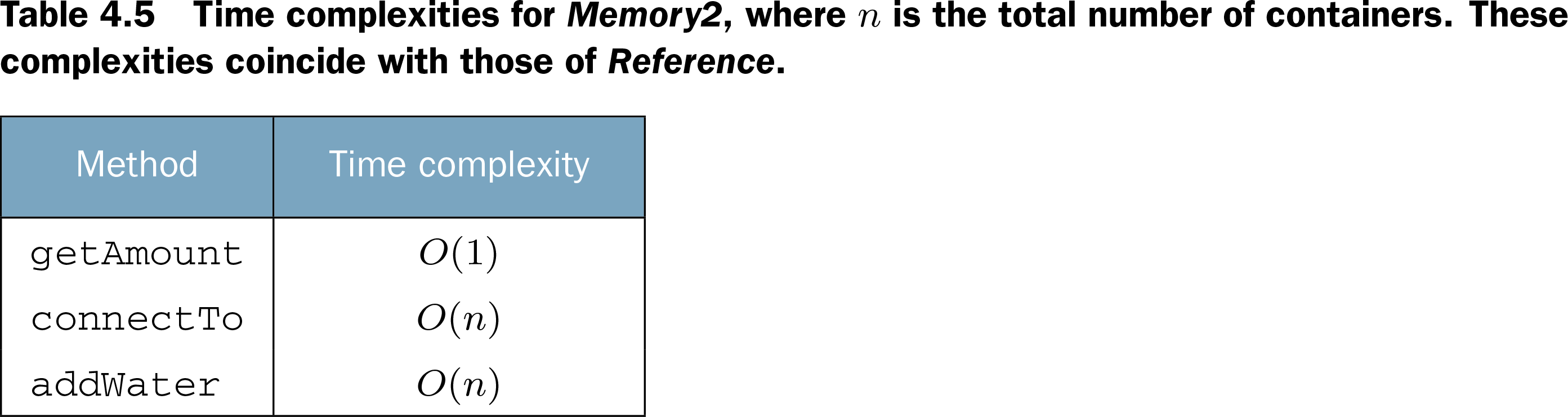
Regarding performance, the time complexity of Memory2 turns out to be the same as Memory1 and Reference, as reported in table 4.5. After all, Memory2 is just a variation of Memory1 with plain arrays instead of ArrayLists.
Table 4.5. Time complexities for Memory2, where n is the total number of containers. These complexities coincide with those of Reference. (view table figure)
Method
Time complexity
getAmount O(1) connectTo O(n) addWater O(n) You may be wondering why the smart resizing policy of ArrayList, which guarantees amortized constant-time insertions, doesn’t provide any advantage to Memory2. The explanation is that it does provide some advantage in the performance of connectTo, but the other operations the method performs hide that advantage. In detail, Memory1 merges two groups through the line

This is an excerpt from Manning's book The Mikado Method.
On the other hand, the reasons may not be valid anymore. Once, Ola was asked to take over a system where the original developers were about to quit. The system was written using an object-relational mapping framework, and the performance degraded horrifically as the amount of data grew, partly because of the framework itself, and partly because of the objects created by it. Using this framework was the easy path functionality-wise, but only for the initial load. It took about a year and the assistance of a colleague to start getting the functionality performant, slowly removing the old structures piece by piece, making extensive use of the Mikado Method.
From the Mikado Method perspective, we prefer faster feedback while exploring a system and growing a graph, so load and performance tests can be a bit too slow. But if you have those types of tests, run them as often as you can, such as over lunch, or during the night, so that you’re alerted if any of your changes have degraded performance significantly. Keep in mind that sometimes you need to first make structural changes and then optimize the new structure, meaning that performance will be degraded for awhile. During this time, the system isn’t releasable, and extra care must be taken to avoid getting stuck in this situation for too long.

This is an excerpt from Manning's book Becoming Agile ...in an imperfect world.
The Virginia Satir change curve (figure 4.1) illustrates how change initiatives cause organizations to go through an intense period of resistance and chaos and how these periods cause a drop in performance. (Virginia Satir is a family therapist who created a change model to help families understand and deal with change.) No wonder executives are concerned about the risks associated with any change initiative. They want to ensure that the transition goes as smoothly as possible. They also want to find ways to shorten or eliminate the resistance and chaos phase (figure 4.1c). Financial and productivity losses are usually incurred when the period of resistance and chaos is prolonged (figure 4.1b).
We’ve seen issues with performance, browser compatibility, security, and product compatibility. The list of issues you can encounter is infinite.

This is an excerpt from Manning's book Test Driven: Practical TDD and Acceptance TDD for Java Developers.
Wanting to get an idea of whether our template engine is any good performance-wise, let’s quickly add a test for the performance of evaluate to see whether we’re close to a reasonable execution time. Listing 2.19 presents our new test class for such a micro-performance check.