concept SCM in category software development

This is an excerpt from Manning's book Agile Metrics in Action: How to measure and improve team performance.
SCM is where the action is; that’s where developers are checking in code, adding reviews, and collaborating on solutions. I’ve often been on teams where it was like pulling teeth to get developers to move cards or add comments in the project tracking system, which ends up leading to a huge blind spot for anyone outside the development team interested in the progress of a project. You can eliminate that blind spot by looking at the data generated by the use of your SCM.
If we revise the questions we asked in chapter 3, we get the types of who, what, and how through data from SCM, as shown in figure 4.2.

The minimum set of data you can get from SCM is the amount of code everyone on your team is changing. With no other data you can get answers to questions like these:

This is an excerpt from Manning's book Agile ALM: Lightweight tools and Agile strategies.
This chapter introduces the concepts that are essential to understanding Agile ALM, including the evolution of software engineering with its migration to Agile ALM. I’ll also discuss the essential impact that SCM (and version control) has had on ALM, including some of the first pilot projects to use Agile and ALM together. In addition, I’ll explain my view that SCM is the basis of ALM and how these practices help develop ALM today. Many Agile books make the case that one doesn’t adopt Agile practices, but rather one becomes Agile. It’s important to establish an effective ALM through people, culture, processes, and tools. This chapter will also focus on open source and lightweight tooling along with the building blocks of Agile ALM. That’s not to say that some large-scale commercial tools aren’t worth using, but they won’t be the focus of this book.
Running an unreliable, fragmented development process doesn’t empower a team to track and improve their work continuously. This is where software configuration management (SCM) can help. SCM helps improve the development process by tracking and controlling changes in the software. These processes are commonly implemented using version-control systems (VCS). SCM makes changes in the VCS visible, and it adds meta-information to the system to track why the change was made. Above all, baselines (identifying a specific version of the code suitable for release) and change-sets (linked to artifacts or work items) provide traceability to the development process and accelerate release management.
The following are the goals and values of SCM:
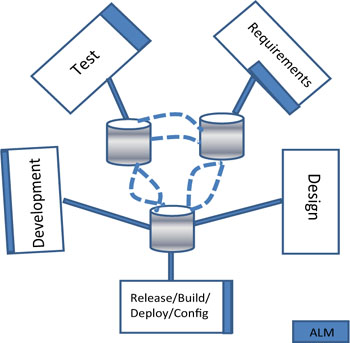
Figure 1.4. The first evolution of SCM toward an approach that can be called ALM spread over phases and synchronization. Unlike the design in figure 1.3, single phases now contain aspects of ALM but often have disparate data stores and processes, and there are challenges to sharing data and knowledge.