concept strategy in category software development

This is an excerpt from Manning's book Agile ALM: Lightweight tools and Agile strategies.
An Agile ALM enriches a traditional ALM with Agile values and strategies. With a focus on communication and collaboration, ALM processes already have the prerequisites to support Agile software development. An Agile ALM has its major focus on human interaction (“peopleware”), increasing their communication and interactions by implementing Agile strategies (like continuous integration) and always weighing value and effort. The Agile approach uses lightweight tools as needed, based on concrete requirements. In this book, I will refer to large, bureaucratic, heavyweight systems as being monolithic, as discussed later in this chapter. A nonmonolithic approach uses open standards and helps to implement an Agile software development process. Agile ALM can also support other kinds of development processes.
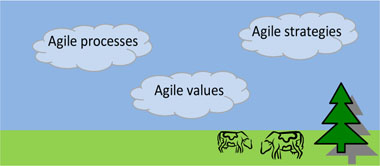
Agile is a term applied to different process models. On the one hand, there are pure Agile models, such as Scrum, Extreme Programming, and DSDM (www.dsdm.org).[3] On the other hand, there are models that can implement an Agile approach, like the Rational Unified Process. Finally, Agile is also used to describe strategies that incorporate an Agile approach. Figure 2.1 illustrates these three dimensions as features of the Agile ecosystem.
In this book, I don’t dictate any specific process model for developing software. You can use rich, full-fledged models like waterfall, spiral, or a hybrid type. The point is that you can enrich your current processes where it makes sense for you by using Agile strategies. Furthermore, these strategies aren’t dependent on any specific tools (though I will recommend some). Think of Agile as a value system, a set of strategies, and a toolbox.