concept transformation in category software development

This is an excerpt from Manning's book Event Processing in Action.
If you decide to build your own event processing application from the ground up, you can still follow the principles described in this book. You can structure your application as shown in figure 1.5 and develop a set of software components, each of them written to perform a specific function, corresponding to the event processing agents that we discuss in this book. These software components can communicate by sending event instances over a messaging system, such as Java Message Service (JMS). You might want to use an enterprise service bus to perform some of the simpler event processing functions, such as transformation, filtering, and routing.
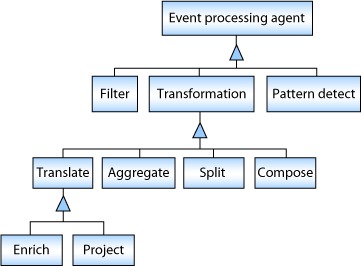
The effect of filtering and transformation on event header elements As usual we illustrate the concepts with examples from the Fast Flower Delivery application and examples from other fictional applications. We start with the discussion of filtering and then move on to transformation later in the chapter.
Listing 8.1. XSLT stylesheet performing the transformation
<xsl:stylesheet xmlns:xsl="http://www.w3.org/1999/XSL/Transform" version="1.0" > <xsl:template match="/event"> <event> <orderType> Low </orderType> <price> <xsl:value-of select="round (100*//price div 1.15) div 100" /> </price> <total> <xsl:value-of select="//price * //numItems" /> </total> </event> </xsl:template> </xsl:stylesheet>