concept view component in category software development

This is an excerpt from Manning's book Test Driven: Practical TDD and Acceptance TDD for Java Developers.
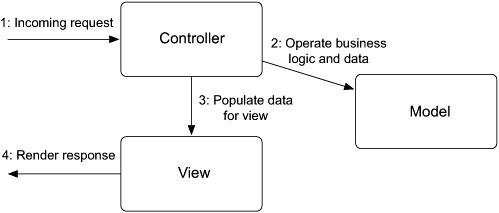
Figure 5.1. The division of responsibilities in the MVC architecture is straightforward. The lifecycle of a request begins with the controller component receiving an incoming HTTP request. The controller then delegates any business logic and data manipulation to the model components and obtains the necessary data from the model. In the third step, the controller populates the necessary data and domain objects for the response, finally delegating the rendering of the response to a view component.
In listing 8.4, our test class’s setup method creates the view component we want to test and
places it into a JFrame for display onscreen. Because we’re creating new frames in the setup, we also need to get rid of them by
disposing of the frames in the teardown method. This is the kind of common plumbing code that we should move into a common base class as soon as we create our second Jemmy test case.
To finish this chapter, we’re going to test-drive a view component. Exactly what kind of a view component? That’s a good question, and I’m glad you asked. We’re going to build a plot map component. What do I mean by a plot map component? Let’s pull up some virtual pen and paper and look at figure 8.4.