concept work in category software development

This is an excerpt from Manning's book Agile Metrics in Action: How to measure and improve team performance.
How consistent is the team in completing work?
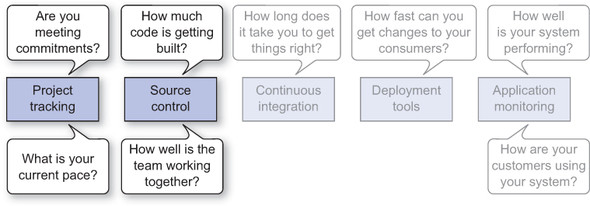
Here are some questions you can answer with just SCM data:
- Who is working on what?
- Who is helping whom?
- How much effort is going into the work?

This is an excerpt from Manning's book The Mikado Method.
When you perform small changes, you can keep them in your head, but for larger ones, the chances of getting lost in a jungle of dependencies, or on a sea of broken code, increases dramatically. The Mikado Method can help you visualize, plan, and perform business value–focused improvements over several iterations and increments of work, without ever having a broken codebase during the process.
Many organizations and corporations have technical policies that state what products are allowed to be used. Often the idea behind this is to simplify the work for IT operations, in an attempt to limit the number of technologies they have to handle.

This is an excerpt from Manning's book Kanban in Action.
“Which, in turn,” Marcus cut in, a happy grin on his face, “will make it easier to prioritize. Fewer items to start with, but you now have something to show and reason about. The work you’re doing is right there, on the board.”
Partially done work— Work that isn’t completely done is in reality just work in process. It lies around waiting for you to complete it and adds to your WIP. See chapter 5 for more on this.
This is a good practice that makes everyone talk at the meeting, and you get a great status overview for each person in the team. But you might miss the opportunity to talk about the work at hand. Maybe there’s one item that’s blocked, and it could be worth spending the entire meeting talking about how to clear it up. Or maybe nothing is blocked, and work is flowing along as expected; then you can close the meeting early and not drag it out more than needed.
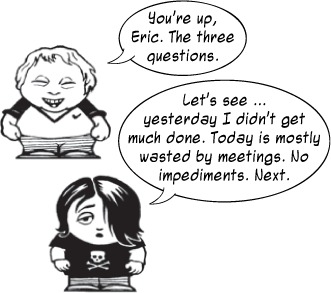
Finally and maybe most importantly, the focus isn’t on what individual people have or haven’t done but rather on whether there are any problems in the flow, in your process, or with individual work items. It helps you understand that you’re a team whose members help each other get the work done together.
Limiting WIP is of course an essential practice when it comes to keeping the work moving. The fewer things in process, the faster the work will flow and the more improvement opportunities you’ll discover. You might remember Little’s law, which states that the more WIP you have, the longer the lead time for each item is. You can read much more about this in chapter 5.

This is an excerpt from Manning's book Specification by Example: How Successful Teams Deliver the Right Software.
An objective means to measure when a piece of work is complete.

This change also affected the division of labor. Previously, work was mostly organized by technical tasks. With such technical chunks of work, they found it hard to work out a specific acceptance criteria for each task. The team moved the focus away from the implementation tasks to the value that a feature should deliver. They started describing stories from the user perspective, which made it easier to discuss and specify the acceptance criteria for chunks of work.
This new organization also allowed them to release software more often. Because technical tasks depended on each other, developers were reluctant to deploy a task until everything in a larger block of work was complete. By focusing on user stories, they worked on independent, smaller chunks that could be released more often.

This is an excerpt from Manning's book Becoming Agile ...in an imperfect world.
Simplicity—the art of maximizing the amount of work not done—is essential. No code means no bugs. The more code you write, the more bugs your code may have. If something isn’t essential to the product, then don’t build it. Some developers tend to develop massive underlying frameworks and infrastructures in the system under the assumption that those elements may be needed in the future. The key is simplicity: try not to develop anything that isn’t essential to the features you’re developing now. Remember, the more time you invest in anything, the more you get attached to it. This attachment makes it harder to accept the fact that you don’t need a piece of code or that you need to change it.
Continue the incomplete features into the next iteration. When you do this, you should still demonstrate status of the incomplete work. You need to have a feel for the work remaining so you can estimate it for the next iteration. You should also get feedback from the customer. Anything you can demonstrate will help you with this goal. Teams frequently create temporary user interfaces or test harnesses to demonstrate status on incomplete features.
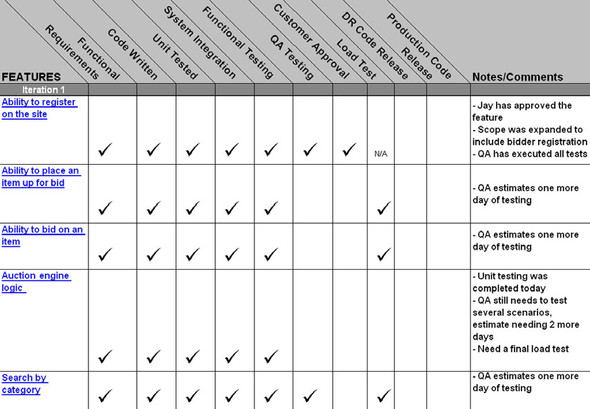
Figure 20.3. The status of the work for iteration 1. Most of the features are going through their final tests, but the auction engine is running late. It isn’t uncommon for a feature to run late during an iteration, even with daily management. The main question is whether you can demonstrate all the features.

This is an excerpt from Manning's book Test Driven: Practical TDD and Acceptance TDD for Java Developers.
TDD remedies this situation by making sure that there’s practically no code in the system that is not required—and therefore executed—by the tests. Through extensive test coverage and having all of those tests automated, TDD effectively guarantees that whatever you have written a test for works, and the quality (in terms of defects) becomes more of a function of how well we succeed in coming up with the right test cases.
The main downside to exposing hooks from our application is the potential effort required to do so. Implementing a facility for remote access to your application’s widgets and internal state can be a significant investment, especially for smaller projects. Furthermore, splitting our test implementation into two places—the test code and the hooks it uses—can slow things down. This notion brings us to question whether we could avoid splitting the work somehow. We know at least one way to do that: by bringing the test code and the application inside the same process.
A less suspicious-sounding trick to doing less work is to share the workload among multiple workers. Let’s talk a bit about distributing work.