concept cluster in category spark
appears as: cluster, clusters, cluster, A cluster
This is an excerpt from Manning's book Spark in Action, Second Edition.
Listing 6.1 Calculating an approximation of π
package net .jgp.books.spark.ch05.lab200_pi_compute_cluster;
...
public class PiComputeClusterApp implements Serializable {
...
     private final class DartMapper
         implements MapFunction<Row, Integer> {
...
    }

     private final class DartReducer implements ReduceFunction<Integer> {
...
    }

     public static void main(String[] args ) {
      PiComputeClusterApp app = new PiComputeClusterApp();
       app .start(10);
    }

     private void start(int slices ) {
       int numberOfThrows = 100000 * slices ;
...
      SparkSession spark = SparkSession #1
            .builder() #1
            .appName( "JavaSparkPi on a cluster" ) #1
            .master( "spark://un:7077" ) #1
            .config( "spark.executor.memory" , "4g" ) #1
            .getOrCreate(); #1
...
      List<Integer> l = new ArrayList<>( numberOfThrows );
       for ( int i = 0; i < numberOfThrows ; i ++) {
         l .add( i );
      }
      Dataset<Row> incrementalDf = spark #2
            .createDataset( l , Encoders.INT()) #2
            .toDF(); #2
...
      Dataset<Integer> dartsDs = incrementalDf #3
            .map( new DartMapper(), Encoders.INT()); #3
...
       int dartsInCircle = dartsDs .reduce( new DartReducer()); #4
...
      System. out .println( "Pi is roughly " +
➥ 4.0 * dartsInCircle / numberOfThrows );

       spark .stop();
    }
 }
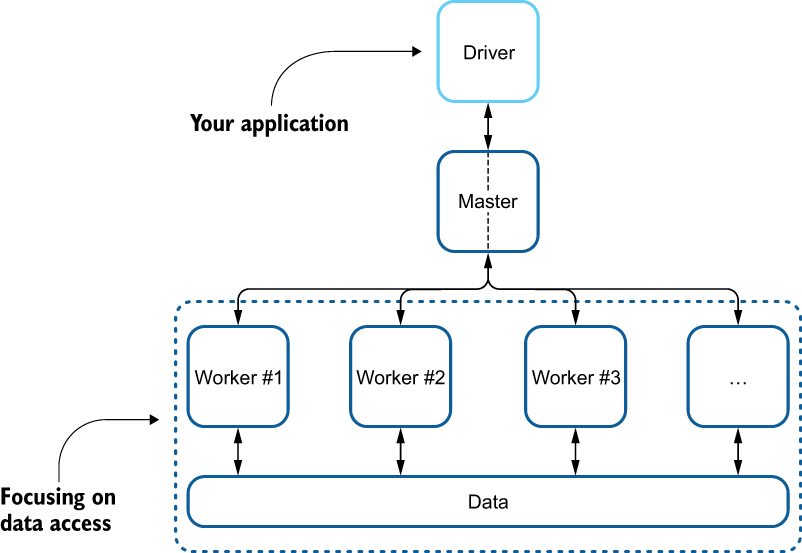
Spark applications run as independent processes on a cluster. The
SparkSessionobject in your application (also called the driver ) coordinates the processes. There is a uniqueSparkSessionfor your application, whether you are in local mode or have 10,000 nodes. TheSparkSessionis created when you build your session, as in the following: