concept Delta Lake in category spark
This is an excerpt from Manning's book Spark in Action, Second Edition.
Delta Lake is a database at the heart of the Spark infrastructure. You will first learn what Delta Lake is, why it is needed, and in which contexts it should be used. You will then build your first application to feed Delta Lake. You will finish with two smaller applications that consume data stored in the database.
Delta Lake was initially known as Databricks Delta and was available in the Databricks cloud offering. At Spark Summit in May 2019, Databricks open sourced Delta under an Apache license: it became Delta Lake ( https://delta.io/ ). You will not have to download anything, as Delta Lake simply installs as a Maven dependency, as you will see in section 17.2.2.
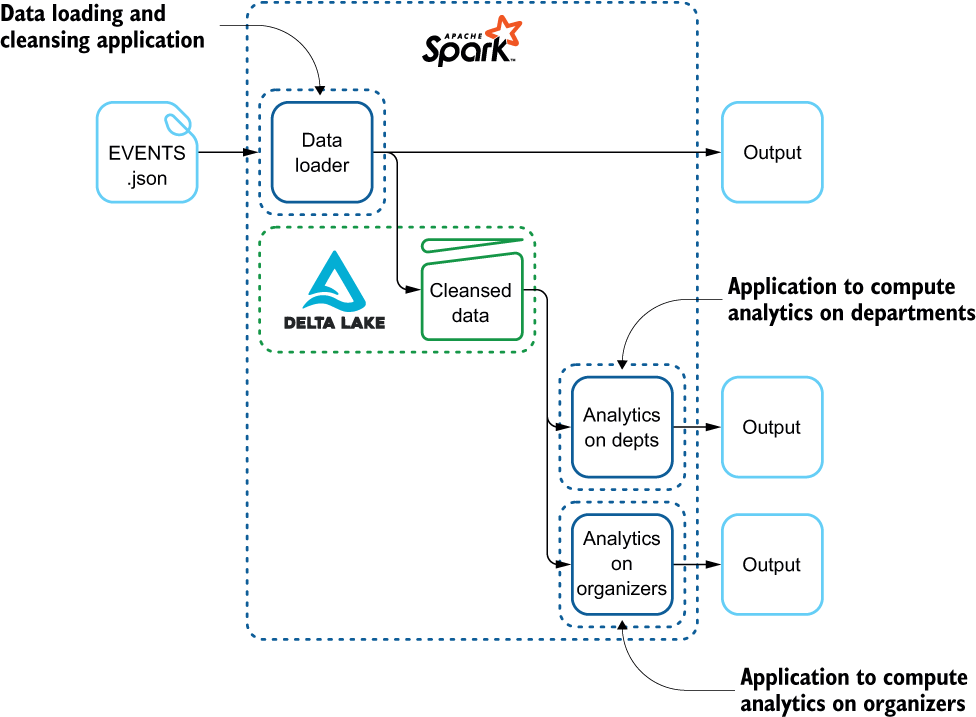
Figure 17.7 shows the data pipeline you are going to build. Additionally, you will build two applications that will consume the data from Delta Lake to perform some analytics: calculating the number of meetings per department (an administrative subdivision similar to the United States’ counties ) and a basic analysis of the types of organizers.
Listing 17.8 Data loader
package net.jgp.books.spark.ch17.lab200_feed_delta;

import static org.apache.spark.sql.functions.col;
import static org.apache.spark.sql.functions.expr;
import static org.apache.spark.sql.functions.when;

import org.apache.spark.sql.Dataset;
import org.apache.spark.sql.Row;
import org.apache.spark.sql.SparkSession;
import org.apache.spark.sql.types.DataTypes;
import org.apache.spark.sql.types.StructField;
import org.apache.spark.sql.types.StructType;

public class FeedDeltaLakeApp {
...
     private void start() {
      SparkSession spark = SparkSession.builder() #1
            .appName( "Ingestion the 'Grand Débat' files to Delta Lake" ) #1
            .master( "local[*]" ) #1
            .getOrCreate(); #1

      StructType schema = DataTypes.createStructType( new StructField[] { #2
            DataTypes.createStructField(
                 "authorId" ,
                DataTypes. StringType ,
                 false ),
...
            DataTypes.createStructField( #3
                 "createdAt" , #3
                DataTypes. TimestampType , #3
                 false ), #3
...

      Dataset<Row> df = spark .read().format( "json" ) #4
            .schema( schema )
            .option( "timestampFormat" , "yyyy-MM-dd HH:mm:ss" ) #5
            .load( "data/france_grand_debat/20190302 EVENTS.json" );

       df = df
            .withColumn( "authorZipCode" , #6
col( "authorZipCode" ).cast(DataTypes. IntegerType )) #6
            .withColumn( "authorZipCode" , #6
when(col( "authorZipCode" ).$less(1000), null ) #6
                      .otherwise(col( "authorZipCode" ))) #6
            .withColumn( "authorZipCode" , #6
                when(col( "authorZipCode" ).$greater$eq(99999), null ) #6
                      .otherwise(col( "authorZipCode" ))) #6
            .withColumn( "authorDept" , expr( "int(authorZipCode / 1000)" )); #8
       df .show(25); #9
       df .printSchema(); #9

       df .write().format( "delta" ) #10
            .mode( "overwrite" ) #11
            .save( "/tmp/delta_grand_debat_events" ); #12

      System. out .println( df .count() + " rows updated." ); #13
    }
 }