concept batch application in category spring

This is an excerpt from Manning's book Spring Batch in Action.
Batch applications are a challenge to write, and that’s why Spring Batch was created: to make them easier to write but also faster, more robust, and reliable. What are batch applications? Batch applications process large amounts of data without human intervention. You’d opt to use batch applications to compute data for generating monthly financial statements, calculating statistics, and indexing files. You’re about to discover more about batch applications in this chapter. You’ll see why their requirements—large volumes of data, performance, and robustness—make them a challenge to implement correctly and efficiently. Once you understand the big picture, you’ll be ready to meet Spring Batch and its main features: helping to efficiently process data with various types of technologies—databases, files, and queues. We also honor the In Action series by implementing a real-world Spring Batch job. By the end of this first chapter, you’ll have an overview of what Spring Batch does, and you’ll be ready to implement your first job with Spring Batch. Let’s get started with batch applications!
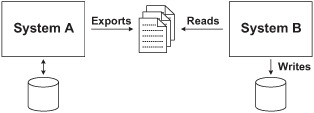
The most common scenario for a batch application is exporting data to files from one system and processing them in another. Imagine you want to exchange data between two systems: you export data as files from system A and then import the data into a database on system B. Figure 1.1 illustrates this example.
Figure 1.1. A typical batch application: system A exports data to flat files, and system B uses a batch process to read the files into a database.
A batch application processes data automatically, so it must be robust and reliable because there is no human interaction to recover from an error. The greater the volume of data a batch application must process, the longer it takes to complete. This means you must also consider performance in your batch application because it’s often restricted to execute within a specific time window. Based on this description, the requirements of a batch application are as follows:
Large data volume— Batch applications must be able to handle large volumes of data to import, export, or compute.