concept context in category spring

This is an excerpt from Manning's book Spring Security in Action.
In this example, the responses A and B are different results of calling the same authentication endpoint. They don’t seem to expose any information related to the class design or system infrastructure, but they hide another problem. If the messages disclose context information, then they can as well hide vulnerabilities. The different messages based on different inputs provided to the endpoint can be used to understand the context of execution. In this case, they could be used to know when a username is correct, and only the password is wrong. And this can make the system more liable to a brute force attack. The response provided back to the client shouldn’t help in identifying a possible guess of a specific input. In this case, it should have better provided in both situations the same message:
The @RestController annotation registers the bean in the context and tells Spring that the application uses this instance as a web controller. Also, the annotation specifies that the application has to set the returned value from the response body of the HTTP response. The @GetMapping annotation maps the /hello path to the implemented method. Once you run the application, besides the other lines in the console, you should see something that looks similar to this:
Listing 17.12 Adding the SecurityEvaluationContextExtension to the context.
@Configuration
@EnableGlobalMethodSecurity(prePostEnabled = true)
public class ProjectConfig {

  @Bean    #A
  public SecurityEvaluationContextExtension
    securityEvaluationContextExtension() {

    return new SecurityEvaluationContextExtension();
  }

    // Omitted declaration of the UserDetailsService and PasswordEncoder
}
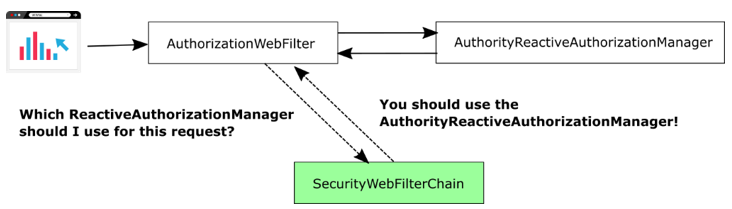
Figure 19.7 The AuthorizationFilter uses the SecurityWebFilterChain bean we added to the context (shaded differently) to know which ReactiveAuthorizationManager to use.

This is an excerpt from Manning's book Dependency Injection: Design Patterns Using Spring and Guice.
Worthy as they are of a heavyweight bout, these two terms are not really opposed to one another as the heading suggests. You will come across the term IoC quite often, both in the context of dependency injection and outside it. The phrase Inversion of Control is rather vague and connotes a general reversal of responsibilities, which is nonspecific and could equally mean any of the following:
Is the context that this scope represents clearly defined?
@At("/home") @Select("action") @RequestScoped
public class HomePage {
    //user context, tracks current user
private final User user;

    //page state variables
    private List<Tweet> tweets;
    private Tweet newTweet = new Tweet();

    //service dependencies
    private final TweetManager tweetManager;

    @Inject
    public HomePage(TweetManager tweetManager, User user) {
        this.tweetManager = tweetManager;
        this.user = user;
    }

    ...
}