concept dependency in category spring

This is an excerpt from Manning's book Spring Microservices in Action, 2E.
Explicitly declare the dependencies your application uses through build tools such as Maven, Gradle (Java). Third-party JAR dependence should be declared using their specific versions number. This allows your microservice to always be built using the same version of libraries.
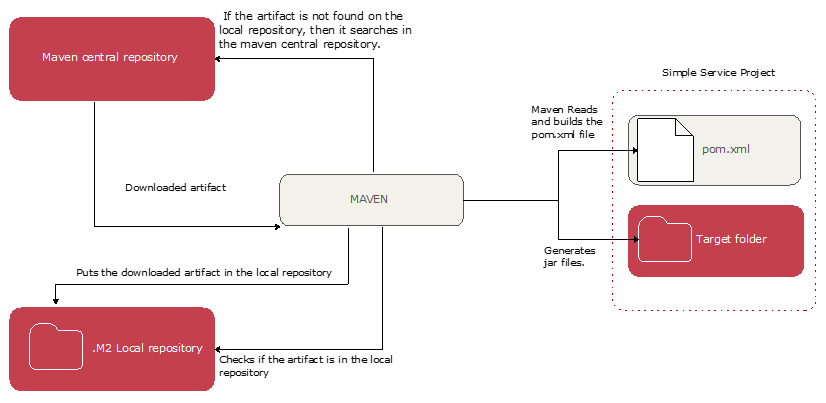
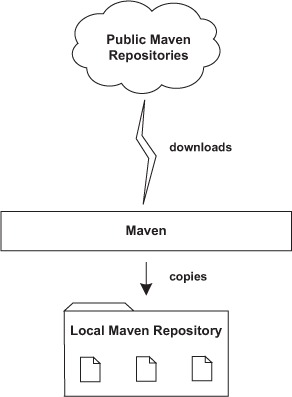
If you are new to the build tools concept, the following figure can help you understand how a build tool work. First, maven reads the dependencies stored in the pom.xml file, then it searches them on the local repository. If they are not found over there, then it proceeds to download them from the maven central repository and inserts them into your local repository for future uses. Figure 2.5 shows how Maven works.
Figure 2.5 Maven reads the dependencies stored in the pom.xml file and then searches them on the local repository. If they are not found on the local repository, then Maven proceeds to download and it also downloads the dependencies of those dependencies from the maven central repository and puts them into your local repository.
In this section, I will show you how to implement Spring HATEOAS in the license service. The first thing we must do to send the links related to a resource in the response is adding the HATEOAS dependency into the pom.xml
file. Please add the following dependency to your pom.xml
            <dependency>
                   <groupId>org.springframework.boot</groupId>
                   <artifactId>spring-boot-starter-hateoas</artifactId>
          </dependency>
Once we have the dependency now, we have to update the License
class in order to extend from RepresentationModel<License>
as shown in code Listing 3.12.

This is an excerpt from Manning's book Spring Security in Action.
Using dependencies with known vulnerabilities
These default implementations serve only as a proof of concept and allow us to see that the dependency is in place. This default implementation stores the credentials in memory; the application doesn’t persist the credentials. This approach is suitable for examples or proof of concepts, but you’ll avoid it with a production-ready application.
Listing 11.6 Autowiring the dependencies in the UserService class
@Service
@Transactional
public class UserService {

  @Autowired
  private PasswordEncoder passwordEncoder;

  @Autowired
  private UserRepository userRepository;

  @Autowired
  private OtpRepository otpRepository;


}
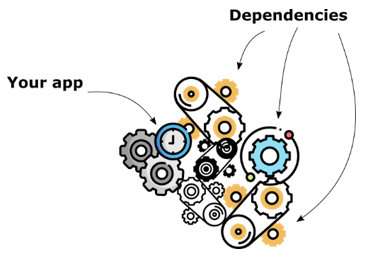
Figure 20.2 The functionality of an application relies on many dependencies. Whenever you upgrade or change a dependency, you might affect existing functionality. Having integrations tests with the dependencies helps you to discover fast if a change in any dependency affected the existing functionality of your application.

This is an excerpt from Manning's book Spring Boot in Action.
Sometimes the hardest part of a project is getting started. You need to set up a directory structure for various project artifacts, create a build file, and populate the build file with dependencies. The Spring Boot CLI removes much of this setup work, but if you favor a more traditional Java project structure, you’ll want to look at the Spring Initializr.
dependencies {
  compile "org.springframework.boot:spring-boot-starter-web"
  compile "org.springframework.boot:spring-boot-starter-thymeleaf"
  compile "org.springframework.boot:spring-boot-starter-data-jpa"
  compile "com.h2database:h2"
  testCompile("org.springframework.boot:spring-boot-starter-test")
}
One way you might want to use @GrabMetadata is to work with dependency versions defined in the Spring IO platform (http://platform.spring.io/platform/). The Spring IO platform offers a curated set of dependencies and versions aimed to give confidence in knowing which versions of Spring and other libraries will work well together. The dependencies and versions specified by the Spring IO platform is a superset of Spring Boot’s set of known dependency libraries, and it includes several third-party libraries that are frequently used in Spring applications.
The @Grab annotation comes from Groovy’s Grape (Groovy Adaptable Packaging Engine or Groovy Advanced Packaging Engine) facility. In a nutshell, Grape enables Groovy scripts to download dependency libraries at runtime without using a build tool like Maven or Gradle. In addition to providing the functionality behind the @Grab annotation, Grape is also used by the Spring Boot CLI to fetch dependencies deduced from the code.

This is an excerpt from Manning's book Spring Dynamic Modules in Action.
This problem of static coupling is made worse by issues with the instantiation order of beans. Spring computes a complex dependency graph to determine the order in which beans will be instantiated and injected. This computation is internal to Spring, and application developers can’t get their hands on it. If something goes wrong, debugging can be particularly complex, especially when you have a lot of dependencies. Furthermore, there is very limited support for circular dependencies, putting an even heavier burden on developers to configure their beans correctly.
In the first part, the component is installed into the container without trying to resolve its dependencies. The resolution of dependencies takes place next, when the component tries to reach the resolved state. If errors occur during the resolution of dependencies, the component remains in the installed state. You’ll notice that OSGi allows the refreshing of components, and when this happens, dependency resolution must be performed again. During these steps, other components in the container can’t use the component. Figure 2.2 shows the different states, transitions, and events in the first part of the lifecycle.
As with the previously described headers for consuming packages, the value of this header contains a list of element names, but this time they aren’t package names but rather bundle symbolic names. The matching between exported and imported entities is still based on attributes, but only one standard attribute is defined by the OSGi specification: the bundle-version attribute. The bundle-version attribute uses the same semantics as the version attribute of the Import-Package header and specifies the component version of the dependency. For more details, see section 2.2.5. The following snippet shows a simple use of the Require-Bundle header.
Listing 3.11. Dependencies for JSP and taglib support
<dependency> <groupId>org.springframework.osgi</groupId> <artifactId>jsp-api.osgi</artifactId> <version>2.0-SNAPSHOT</version> <scope>test</scope> </dependency> <dependency> <groupId>org.springframework.osgi</groupId> <artifactId>jasper.osgi</artifactId> <version>5.5.23-SNAPSHOT</version> <scope>test</scope> </dependency> <dependency> <groupId>org.springframework.osgi</groupId> <artifactId>commons-el.osgi</artifactId> <version>1.0-SNAPSHOT</version> <scope>test</scope> </dependency> <dependency> <groupId>org.springframework.osgi</groupId> <artifactId>jstl.osgi</artifactId> <version>1.1.2-SNAPSHOT</version> <scope>test</scope> </dependency>

This is an excerpt from Manning's book Dependency Injection: Design Patterns Using Spring and Guice.
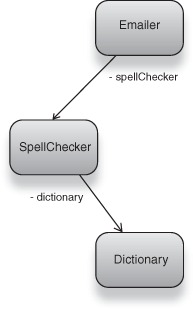
In our example, the Emailer depends on a SpellChecker, a TextEditor, and an AddressBook. This relationship is called a dependency. In other words, Emailer is a client of its dependencies.
Composition also applies transitively; an object may depend on other objects that themselves have dependencies, and so on. In our case, SpellChecker may depend on a Parser to recognize words and a Dictionary of valid words. Parser and Dictionary may themselves depend on other objects.
This composite system of dependencies is commonly called an object graph. This object graph, though composed of many dependencies, is functionally a single unit.
First, let’s formally address what it means to identify components and dependencies. Recall our discussion of the construction and assembly of object graphs from chapter 1. Essentially, a dependency is some implementation of a service. It may only be a flat object with no dependencies of its own. Or it may be an object with a vast graph of interconnected dependencies, which themselves have dependencies, and so on.
Listing 4.6. Refactor the list to a dependency
public class StringSearch { private final HashSet<String> set; public StringSearch(HashSet<String> set) { this.set = set; } public String startsWith(String aString) { Iterator<String> iter = set.iterator(); while(iter.hasNext()) { String current = iter.next(); if (current.startsWith(aString)) return current; } return null; } public boolean contains(String aString) { Iterator<String> iter = set.iterator(); while(iter.hasNext()) { String current = iter.next(); if (aString.equals(current)) return true; } return false; } ... }