concept developer in category spring
This is an excerpt from Manning's book Spring Microservices in Action, 2E.
Software architecture refers to all the fundamental parts that allow us to establish the structure, operation, and interaction between the components of the software. To create a good architecture, we can use as a guide the design patterns; these patterns provide the necessary framework to guide the development of software, allowing developers to share the same line of work and cover all objectives and application restrictions.
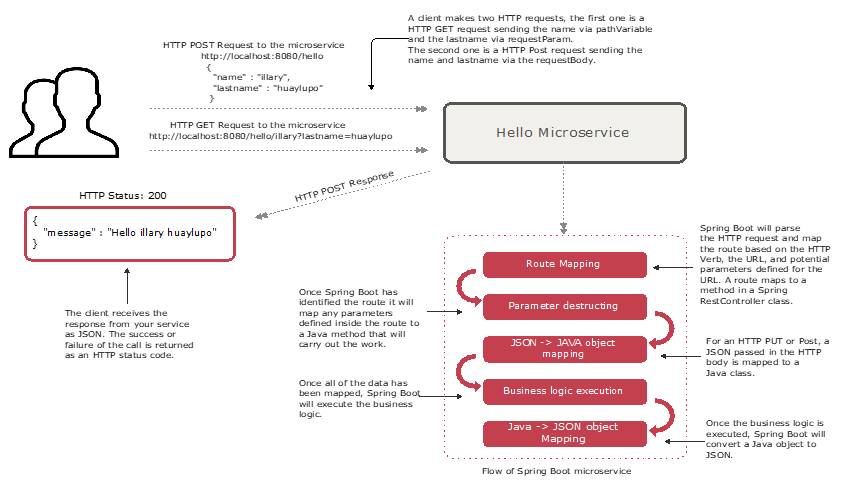
Figure 1.5 Spring Boot abstracts away the common REST microservice task (routing to business logic, parsing HTTP parameters from the URL, mapping JSON to/from Java Objects), and lets the developer focus on the business logic for the service. This figure shows three different ways to pass parameters to our controller.
An architect’s role in a software project is to provide a working model of the problem that needs to be solved. The job of the architect is to provide the scaffolding against which developers will build their code so that all the pieces of the application fit together.

This is an excerpt from Manning's book Spring Security in Action.
Generally, as developers, we start by learning that the purpose of an application is to solve business cases. This purpose refers to something where data could be processed somehow, persisted, and eventually displayed to the user in a specific way as specified by some requirements. This overview of software development, which is somehow imposed from the early ages of learning development, has the unfortunate disadvantage of hiding practices that are also part of the process. While the application works correctly from the user’s perspective, and in the end, it does what the user expects in terms of functionalities, there are lots of aspects hidden in the final result.
Figure 1.9 A developer applies the authorization rules at the controller layer. But the repository does not know and does not restrict the retrieval of data anyhow. If a service asked for accounts that don’t belong to the currently authenticated user, the repository would return them.
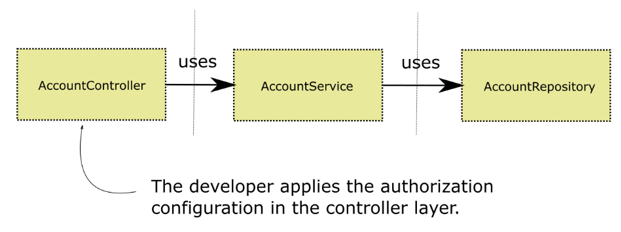
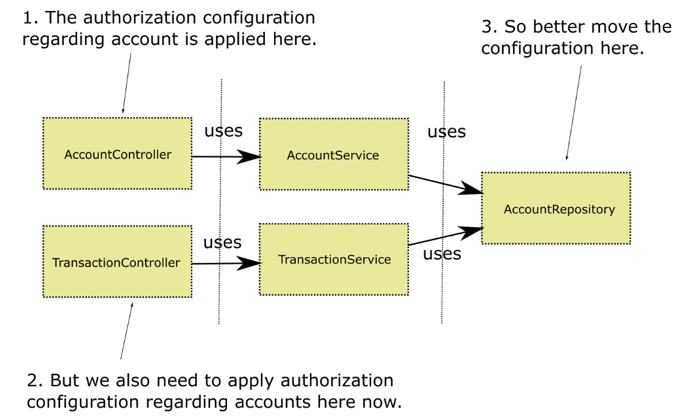
While the case presented in figure 1.9 works correctly, applying the authorization rules only at the controller layer might leave room for error. In this case, some future implementation could expose that use case without testing or without testing all the authorization requirements. In figure 1.10, you can see what could happen if a developer adds another functionality that depends on the same repository.
Figure 1.10 The newly added TransactionController makes use of the AccountRepository in its dependency chain. The developer must reapply the authorization rules in this controller as well. But it would be much better if the repository itself made sure that data that doesn’t belong to the authenticated user is not exposed.
This is an excerpt from Manning's book Spring Microservices in Action.

Communication protocols— How will developers communicate with your service? Do you use XML (Extensible Markup Language), JSON (JavaScript Object Notation), or a binary protocol such as Thrift to send data back and forth your microservices? We’ll go into why JSON is the ideal choice for microservices and has become the most common choice for sending and receiving data to microservices. I cover communication protocols in chapter 2. Interface design— What’s the best way to design the actual service interfaces that developers are going to use to call your service? How do you structure your service URLs to communicate service intent? What about versioning your services? A well-design microservice interface makes using your service intuitive. I cover interface design in chapter 2.
An architect’s role on a software project is to provide a working model of the problem that needs to be solved. The job of the architect is to provide the scaffolding against which developers will build their code so that all the pieces of the application fit together.
When building a microservice, moving from the conceptual space to the implementation space requires a shift in perspective. Specifically, as a developer, you need to establish a basic pattern of how each of the microservices in your application is going to be implemented. While each service is going to be unique, you want to make sure that you’re using a framework that removes boilerplate code and that each piece of your microservice is laid out in the same consistent fashion.
In this section, we’ll explore the developer’s priorities in building the licensing microservice from your EagleEye domain model. Your licensing service is going to be written using Spring Boot. Spring Boot is an abstraction layer over the standard Spring libraries that allows developers to quickly build Groovy- and Java-based web applications and microservices with significantly less ceremony and configuration than a full-blown Spring application.

This is an excerpt from Manning's book Spring Integration in Action.
Spring Integration addresses these challenges. It aims to increase productivity, simplify development, and provide a solid platform from which you can tackle the complexities. It offers a lightweight, noninvasive, and declarative model for constructing message-driven applications. On top of this, it includes a toolbox of commonly required integration components and adapters. With these tools in hand, developers can build the types of applications that literally change the way their companies do business.
Spring WS is a Spring portfolio project that focuses on contract-first web services with XML payloads. As mentioned before, not all XML web services use SOAP. Spring WS provides support for POX-based web services, among others. One of the strongest points of Spring WS is that it decouples application code from the relatively complex requirements of SOAP. Developers can code agnostic to the fact that SOAP is being used except where the application requires control over those details. Without the use of an abstraction like Spring WS, the creation of even a simple SOAP message, as in the following example, is relatively complex; it requires a good understanding of XML APIs and namespace usage:

This is an excerpt from Manning's book Spring Roo in Action.
When defined in layers, developers are able to switch each layer’s implementation. It becomes straightforward to switch persistence strategies or user interface implementations. Spring, being a component-driven development framework, fits well with layered architectures. Developers are encouraged to build beans using interface-driven development techniques, defining business method signatures in the interface, and implementing them in a realizing bean. Spring uses the interface as the contract to the client, so that the implementation can be swapped later.
Defining interfaces also helps developers test their components in isolation, using unit testing tools such as JUnit.
Roo includes an add-on component for Cloud Foundry to help developers with the tasks of deploying Roo applications to the cloud. We’ll show you how to configure and deploy your Roo applications using the Cloud Foundry add-on.
CloudFoundry.org —This is the open source community site for developers to collaborate and contribute to the Cloud Foundry project. Micro Cloud Foundry —The Micro Cloud Foundry (http://mng.bz/LCcz) is a local version of the Cloud Foundry service. It runs in a virtual machine on a developer’s Mac or PC. Developers can use Micro Cloud Foundry to run a cloud on their own computers for development and testing purposes. You can build cloud applications locally and deploy them to Cloud Foundry without changing the code.

This is an excerpt from Manning's book Spring Dynamic Modules in Action.
This problem of static coupling is made worse by issues with the instantiation order of beans. Spring computes a complex dependency graph to determine the order in which beans will be instantiated and injected. This computation is internal to Spring, and application developers can’t get their hands on it. If something goes wrong, debugging can be particularly complex, especially when you have a lot of dependencies. Furthermore, there is very limited support for circular dependencies, putting an even heavier burden on developers to configure their beans correctly.
On the other side of the table, the OSGi core specification doesn’t provide any support for patterns or tools in the design and implementation of bundles. This is by design, leaving the developer free to choose a suitable architecture and the framework. Using a framework like Spring can really enhance the power of the platform because it enables the use of dependency injection, AOP, and other modern paradigms. But “here be dragons” because there are obvious challenges in managing the disparate lifecycles of both Spring and OSGi bundles.
Finally, it’s time to look at how to diagnose errors when implementing and executing OSGi components. Developers new to OSGi can find errors difficult to understand and resolve because OSGi provides slightly different mechanisms than classic Java applications.