concept http request in category spring

This is an excerpt from Manning's book Spring Security in Action.
Let’s start with the case where you develop a component of the system that represents a web application. In this application, there’s no direct separation in development between the backend and the frontend. The way we usually see these kinds of applications is through the general servlet flow: the application receives an HTTP request and sends back an HTTP response to a client. Sometimes we might have a server-side session for each client to store specific details over more HTTP requests. In the examples provided in the book, we use Spring MVC (figure 1.11).
In Spring Security, the HTTP filters delegate the different responsibilities that apply to an HTTP request. In chapters 3 through 5, where we discussed the HTTP Basic authentication and authorization architecture, I’ve often referred to filters. You learned that there is a component we named authentication filter, which delegates the authentication responsibility to the authentication manager. You learned as well that a certain filter takes care of the authorization configuration after successful authentication. In general, in Spring Security, the HTTP filters manage each responsibility that must be applied to the request. The filters form a chain of responsibilities. A filter receives the request, executes its logic, and eventually delegates the request to the next filter in the chain (figure 9.1).
Figure 9.1 The filters chain receives the request. Each filter uses a manager to apply specific logic to the request and, eventually, delegates the request further in the chain to the next filter.

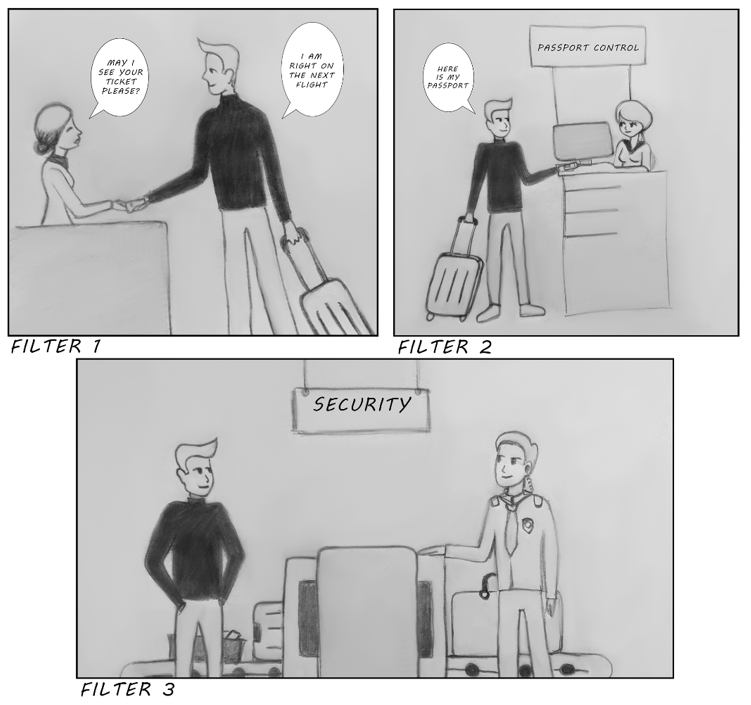
The idea is very simple. When you go to the airport, from entering the terminal to boarding the aircraft, you go through multiple filters (figure 9.2). You first present your ticket, then your passport is verified, and afterward, you go through security. At the airport decision, more filters might be applied. For example, in some cases, right before boarding, your passport and visa are validated once more. This is an excellent analogy to the filter chain in Spring Security. In the same way, you customize filters in a filter chain with Spring Security that will act on the HTTP requests. Spring Security provides filter implementations that you add to the filter chain through customization, but you can also define custom filters.
Figure 9.2 At the airport, you go through a filter chain to eventually board the aircraft. In the same way, Spring Security has a filter chain that acts on the HTTP requests received by the application.

This is an excerpt from Manning's book Spring in Practice.
Java web applications typically realize MVC in roughly the following way: the model encompasses business-tier code (service beans, POJOs, Enterprise JavaBeans [EJBs], and so forth), the view involves JSPs or similar technologies, and the controller is usually servlet-based. HTTP requests come into the servlet, which routes the request to a handler component (sometimes called an action, sometimes called a controller) that in turn processes the request. The handler makes any necessary calls against the service tier and grabs any domain objects[1] it needs to populate the view. Finally, the handler figures out which view to deliver and forwards processing to that view. Figure 3.1 shows the typical flow.
Spring Mobile’s DeviceResolvers use information present in an HTTP request to sniff out the presence of a mobile device. To give you an idea of how this works and what this information looks like, let’s look at how a typical HTTP request is made.

This is an excerpt from Manning's book Spring Batch in Action.
Synchronous launching is good in some cases: if you write a Java main program that a system scheduler like cron launches periodically, you want to exit the program only when the execution ends. But imagine that an HTTP request triggers the launching of a job. Writing a web controller that uses the job launcher to start Spring Batch jobs on HTTP requests is a handy way to integrate with external triggering systems. What happens if the launch is synchronous? The batch process executes in the calling thread, monopolizing web container resources. Submit many batch processes in this way and they’ll use up all the threads of the web container, making it unable to process any other requests.

Imagine that you deployed your Spring Batch environment in a web application, but a system scheduler is in charge of triggering your Spring Batch jobs. A system scheduler like cron is easy to configure, and that might be what your administration team prefers to use. But how can cron get access to Spring Batch, which is now in a web application? You can use a command that performs an HTTP request and schedule that command in the crontab! Here’s how to perform an HTTP request with a command-line tool like wget:
wget "http://localhost:8080/sbia/joblauncher?job=importProductsJob&
  date=20101218"
Figure 4.10 illustrates launching a Spring Batch job with an HTTP request.