concept implementation in category spring

This is an excerpt from Manning's book Spring Security in Action.
Other responsibilities of these components also relate to the data storing as well as transiting data between different parts of the systems. By intercepting the calls to these different parts, the components can act on the data. When the data is stored, these components may apply encryption or hashing algorithms. The data encodings keep the data accessible only to privileged entities. In the Spring application, the developer has to add and configure a component to do this part of the job wherever it’s needed. Spring Security provides us with a contract through which we know what the framework requires to be implemented, and we write the implementation according to the design of the application. We can say the same thing about transiting data.
Listing 3.4 The implementation for the last four methods from the UserDetails interface
public class DummyUser implements UserDetails {

  // Omitted code

  @Override
  public boolean isAccountNonExpired() {
    return true;
  }

  @Override
  public boolean isAccountNonLocked() {
    return true;
  }

  @Override
  public boolean isCredentialsNonExpired() {
    return true;
  }

  @Override
  public boolean isEnabled() {
    return true;
  }

  // Omitted code
}
In this section, we discuss the components which act in an OAuth 2 authentication implementations. You need to know these components and the role they play, as we’ll refer to them from now on in the next sections. I’ll also refer to them through the rest of the book wherever we’ll write an implementation related to OAuth 2. In this section, we only discuss what these components are, and their purpose (figure 12.4). As you’ll learn in section 12.3, there are more ways in which they “talk” one to the other. And in section 12.3, you’ll learn about different flows that cause different interactions between these components.
Figure 17.10 In our scenario, we start by implementing the application using @PostFilter to filter the products based on their owner. Then, we change the implementation to add the condition directly on the query. This way, we make sure the application only gets from the source the needed records.


This is an excerpt from Manning's book Spring Integration in Action.
Now the code is tightly coupled directly to an implementation type. That implementation is being assigned to an interface, and hopefully the caller is never required to downcast. But no matter how you slice it, the code is tied to an implementation because interfaces are only contracts and are separate from the implementations. An implementation type must be chosen for instantiation, and the simplest means of instantiating objects in Java is by calling a constructor.
Spring Integration stays true to enterprise integration patterns (EIP) naming wherever sensible. Not all patterns have their direct counterpart in the API—not every pattern maps directly to an implementation. Some patterns are more conceptual, and others describe a broad category within which implementations may be classified. The message endpoint is an example of such a pattern. The endpoint is too generic to be covered by a single concrete implementation. Instead, we opted for different endpoint implementations in a class hierarchy and explicitly named patterns like transformer, splitter, and router defined in an XML schema. Likewise, taking into account the various external endpoints, the named patterns gateway and channel adapter are defined in an XML schema for each supported type of system (file, JMS, and so on). Other patterns that are supported but not literally implemented include Request-Reply, Selective Consumers, and Return Address. The first two are composite configurations of other components, and the return address pattern is supported by a message header that’s recognized by any reply-producing message handler that doesn’t have an explicit output channel configured.

This is an excerpt from Manning's book Spring Batch in Action.
To update the database with product data, you have to implement your own ItemWriter. Each line of the flat file represents either a new product record or an existing one, so you must decide whether to send the database an insert or an update SQL statement. Nevertheless, the implementation of the ProductJdbcItemWriter is straightforward, as shown in the following listing.
To be complete, the item writer should be restartable. Imagine the system crashes when a job is writing to a file. On a restart, if the reader can start reading where it left off, the writer should also be able to resume its writing exactly where it was interrupted. You should care about restartability on the writer side mainly for file-based writers (good news: the implementations Spring Batch provides are restartable). Database-based writers are usually automatically restartable: they just write the items the reader pushes. So restartability is a reader concern in this case.
Spring Batch includes an implementation of ItemWriter for XML files called StaxEventItemWriter. This writer uses a marshaller to write XML files. A Marshaller is a generic interface provided by the Spring Object/XML Mapping[1] module to convert objects to XML, and vice versa. Spring OXM supports Java Architecture for XML Binding (JAXB) 1.0 and 2.0, Castor XML, XMLBeans, JiBX, and XStream.
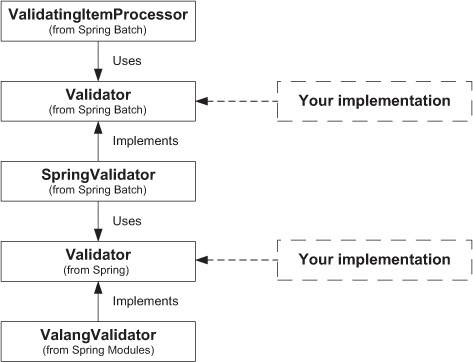
Figure 7.7. The relationships between Spring Batch, Spring, and your validation logic. Spring Batch provides a level of abstraction with its Validator interface and an implementation (SpringValidator) that uses the Spring Validator interface. The ValangValidator implementation, from Spring Modules, depends on the Spring Validator interface. Both Validator interfaces are potential extension points for your own implementations.

This is an excerpt from Manning's book Spring Dynamic Modules in Action.
The BusinessServiceImpl class can easily be decoupled from the notification by introducing a Notifier interface instead of using an implementation. The following snippet shows this solution:
The JPA specification defines the contract for class transformation through the ClassTransformer interface. This interface must be implemented by persistence providers that want to transform entities and managed classes at class load time or at class redefinition time. This feature isn’t mandatory, and implementations are free to use or ignore it.
Specific OSGi imports— Specify all the additional packages in the Import-Package header for the chosen JPA implementation. These packages correspond to hidden classes used at runtime by implementations.