concept integration test in category spring

This is an excerpt from Manning's book Spring Integration in Action.
In the spirit of test-driven design, let’s quickly build an integration test for the transformer. In this case, the integration will include an input and output channel and a simple stub implementation of the FlightScheduler. You don’t need to worry about the actual production version of the FlightScheduler yet; you just want to make sure the transformer is behaving as expected. The following code depicts a sufficient stub implementation:
Matching messages is particularly useful if the framework is doing work that’s important for business concerns. In many cases, the message payload is determined by business logic in Java code, and asserting things about the payload doesn’t make much sense in an integration test (because most of that would already be covered in a unit test around the service). In some cases, though, such as when you use the Spring expression language, things change. Let’s take another example from the sample application.
In figure 18.2 you can see how to generically set up a test that verifies the framework behavior. The example chosen is a service activator that invokes a method on a mock. Arguably, this setup would make sense only as an integration test for the framework, but it serves as a simple example. As the complexity of your configuration increases, it becomes increasingly useful to verify the flow of the messages through the system.

This is an excerpt from Manning's book Spring Dynamic Modules in Action.
As we described earlier, Spring DM uses the local Maven 2 repository to provision the OSGi container it launches for running tests. Spring DM won’t download the dependencies itself, or even ask Maven 2 to do it, so we need to reference them in our project POM and invoke a Maven 2 command to download them. Then they will be in our local repository and will be used each time we launch an integration test using the Spring DM testing framework. Listing 3.4 shows the dependencies in the POM.
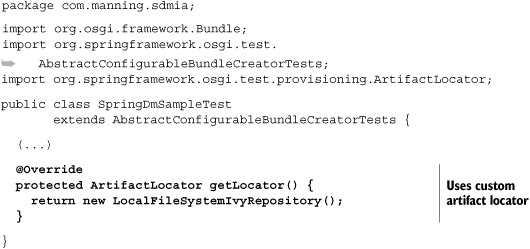
We’ll start with the installation of Ant, and then dive into writing the bundle itself and compiling it with Ant. We’ll then cover how to create an OSGi bundle using Bnd, which integrates nicely with Ant. Apache Ivy will help us handle our dependencies, and we’ll see how to customize Spring DM’s testing framework to make it work with Ivy. We’ll finish by writing and running the integration test with Ant.