concept Java in category spring
This is an excerpt from Manning's book Spring Microservices in Action, 2E.
You want to know if Java and Spring are relevant technologies for building microservice-based applications.
For the licensing service example, we’ll use Java as your core programming language and Apache maven as our build tool.
Listing 4.4 Basic Dockerfile
#Start with a base image containing Java runtime   #A
FROM openjdk:11-slim

# Add Maintainer Info
LABEL maintainer="Illary Huaylupo <illaryhs@gmail.com>"

#Add volume pointing to /tmp
VOLUME /tmp    #B

# The application's jar file
ARG JAR_FILE    #C

# Add the application's jar to the container
COPY ${JAR_FILE} app.jar    #D

#execute the application
ENTRYPOINT ["java","-jar","/app.jar"]    #E
This is an excerpt from Manning's book Spring Microservices in Action.
You want to know if Java and Spring are relevant technologies for building microservice-based applications.
In this chapter, I’ll demonstrate how to design and build a set of microservices from the perspective of each of these roles using Spring Boot and Java. By the time the chapter concludes, you’ll have a service that can be packaged and deployed to the cloud.
For your licensing service example, you’ll use Java as your core programming language and Apache Maven as your build tool.

This is an excerpt from Manning's book Spring Integration in Action.
Another common requirement in enterprise applications is to perform some task at a certain time or repeatedly on the basis of a configured interval. Java provides some basic support for this with java.util.Timer, and, beginning with version 5, a more powerful scheduling abstraction was added: java.util.concurrent.Scheduled-ExecutorService. For functionality beyond what the core language provides, there are projects such as Quartz[9] to support scheduling based on cron expressions, persistence of job data, and more.
Automatic Resource Management in Java 7
Closing resources properly has become easier in Java 7 with Automatic Resource Management.
Central to the filesystem interaction in Java is the File class, which is immutable. This means that once created, it can’t be changed. This is a good thing, because as mentioned earlier, immutable payloads make your life much easier once you start processing messages concurrently. Having a File object as a message payload is perfectly safe from a concurrency point of view. But don’t be lulled into complacency too soon. We all know that files change all the time, so there must be something more to it.

This is an excerpt from Manning's book Spring Roo in Action.
You’ve probably seen the “Twitter in 15 minutes” or “Writing a blogging engine in 1 hour” talks. You’ve probably met the Java developer who says, “I’m never coming back to Java. I just did my first Rails application in 30 days and it was a joy to program.”
Now, we’re not here to bash any frameworks or approaches. But since we’re discussing Roo, which is a framework written in Java, for Java developers, it’s worth discussing some of the differences.
What Spring and Java need is the ability to make it easier to configure and add features to a project, and to remove or hide any generated or mechanical code so you can easily focus on your actual business logic.

This is an excerpt from Manning's book Spring Dynamic Modules in Action.
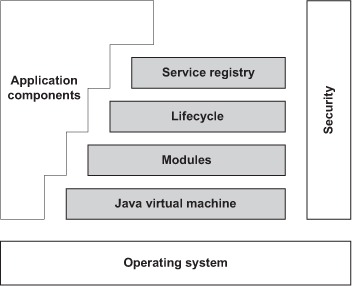
Spring DM—or Spring Dynamic Modules for OSGi Service Platforms, as it’s more formally called—is about using the Spring programming model in OSGi applications. If you’re a Java programmer, you have probably heard of, or used, Spring—the dependency injection framework for Java. But what about OSGi? This dynamic module system for Java may be less familiar; but no matter, Spring DM is about OSGi for the masses, providing OSGi’s modularity features in a neat Spring-shaped package. You don’t need to get too involved in the nitty-gritty of OSGi to benefit from its features.
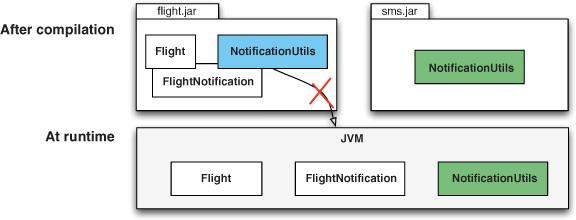
Java is great. We would argue it’s the best general-purpose programming language ever developed, for it addresses many of the deficiencies of languages that went before it. The first step toward modularity lies in the object-oriented features that the Java language offers: splitting applications into classes and enforcing encapsulation with interfaces and visibility modifiers (private, protected, and so on). That’s a good step, but it isn’t enough.

This is an excerpt from Manning's book Dependency Injection: Design Patterns Using Spring and Guice.
As languages, C# and .NET are structurally similar to Java. They are both statically typed, object-oriented languages that need to be compiled. It is no surprise, then, that C# is found in the same problem space as Java and that dependency injectors are applied to equal effect in applications written in C#. However, the prevalence of DI is much lower in the C# world in general. While C# has ports of some Java libraries like Spring and PicoContainer, it also has some innovative DI of its own, particularly in Castle MicroKernel, which does a lot more than just DI. StructureMap, on the other hand, is a mainstay and a more traditional DI library.
Listing 3.5. Compact setter injection (in Java, using Guice)
public class Amplifier { private Guitar guitar; private Speaker speaker; private Footpedal footpedal; private Synthesizer synthesizer; @Inject public void set(Guitar guitar, Speaker speaker, Footpedal footpedal, Synthesizer synthesizer) { this.guitar = guitar; this.speaker = speaker; this.footpedal = footpedal; this.synthesizer = synthesizer; } }
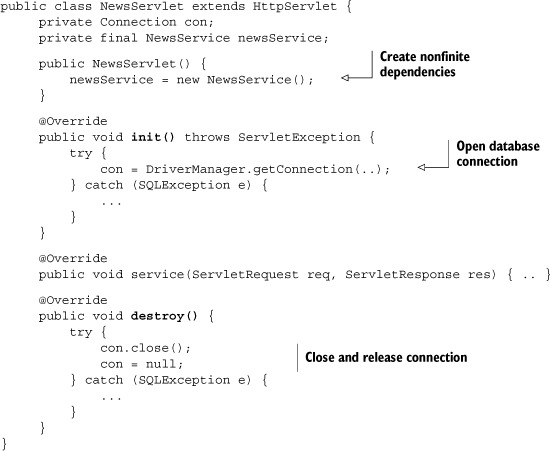
In Java, the explicit task of allocating and reclaiming memory is taken care of by the runtime environment. This frees you from having to worry about when to reclaim allocated objects. Premanaged languages like C++ support an explicit destructor, which acts as a counterpart to constructors. The destructor is a lifecycle event method, which runs once, just prior to memory being freed. Java has something analogous: finalizers. A finalizer is a method that runs just prior to an object being reclaimed by the runtime garbage collector.
Unlike in C++, in Java we cannot guarantee when an object will be reclaimed and therefore when its finalizer runs. The only certainty is that a finalizer will be run before the object is reclaimed. This may be often and early (in the case of aggressive garbage collection), or rare and late, or even right at the shutdown of the application itself, or never if the application exits abnormally. For these reasons, disposal of finite resources (such as network sockets or database connections) inside a finalizer is not a good idea.