concept microservice architecture in category spring
This is an excerpt from Manning's book Spring Microservices in Action, 2E.
Implementing a microservice architecture is not an easy task; it comes with many challenges such as application scalability, service discovery, monitoring, distributed tracing, security, management, and more. However, this book will teach you how to tackle all those challenges, introducing you to the world of microservices in Java, and showing you the importance of applying these architectures to your business applications and the best part explaining you how to achieve it using cutting-edge technologies such as Spring Cloud, Spring Boot, Swagger, Docker, Kubernetes, ELK (Elasticsearch, Logstash, and Kibana) Stack, Grafana, Prometheus, and more.
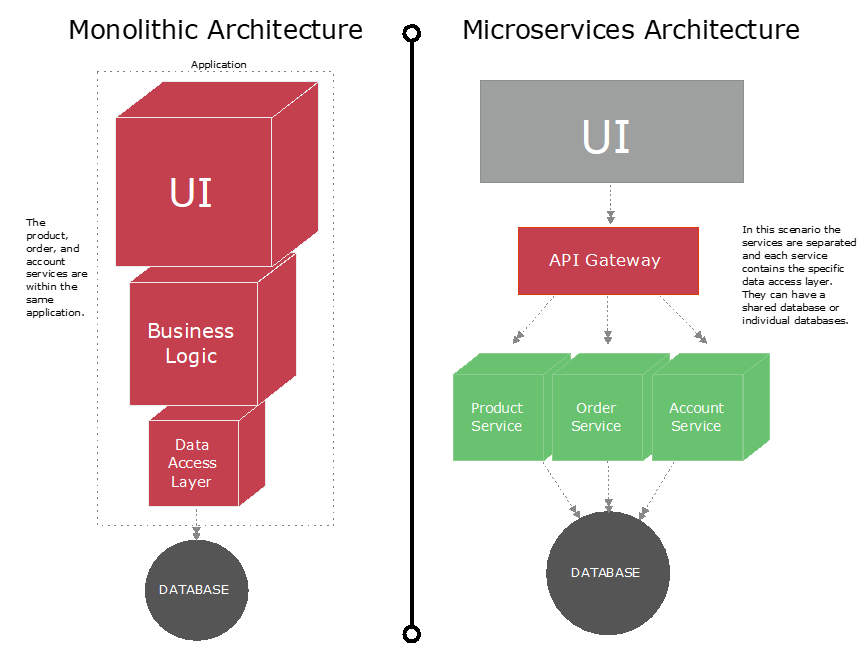
In this book, I'm going to explain how to create a microservice architecture, but to better understand this, I will explain what a monolithic architecture is and the differences between microservices and monolithic architectures. The idea is to give you a good starting point if you are still working with monolithic architectures. Figure 1.1 shows the comparison between a monolithic and a microservice architecture.
Figure 1.1 Comparison between a monolithic architecture and a microservices architecture.
This is an excerpt from Manning's book Spring Microservices in Action.

When building a microservices architecture, a project’s architect focuses on three key tasks: