concept module in category spring

This is an excerpt from Manning's book Spring Dynamic Modules in Action.
OSGi provides a standardized environment that is divided into different layers, as shown in figure 1.5. Each layer has a role in making the OSGi platform modular: enforcing visibility rules between modules, making modules evolve through a set of states, and providing a broker for modules to communicate with each other. Every OSGi container is based on the Java virtual machine (JVM) and specifically implements three layers that enable support for dynamic modularity.
We hope we’ve talked enough about modularity in this book for you to understand that an application should not be built as a monolithic piece of software, nor should it reinvent the wheel each time it needs to do something new. An application should be divided into a consistent set of modules to encourage reuse, testing, and independent upgrades. It should also be able to leverage third-party libraries, which give strong foundations and keeps the focus on the main goal of the application.

This is an excerpt from Manning's book Dependency Injection: Design Patterns Using Spring and Guice.
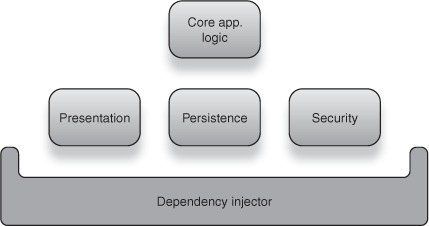
Spring Framework is a groundbreaking and cornerstone dependency injection library of the Java world. It is largely responsible for the popularity and evolution of the DI idiom and for a long time was almost synonymous with dependency injection. Spring was created by Rod Johnson and others and was initially meant to solve specific pains in enterprise projects. It was established as an open source project in 2003 and grew rapidly in scope and adoption. Spring provides a vast set of abstractions, modules, and points of integration for enterprise, open source, and commercial libraries. It consists of much more than dependency injection, though DI is its core competency. It primarily supports setter and constructor injection and has a variety of options for managing objects created by its dependency injector. For example, it provides support for both the AspectJ and AopAlliance AOP paradigms.
A class can itself be a member of a larger unit of collective responsibilities called a module. A module is an independent, contractually sound unit that is focused on a broad part of business responsibility. For example, a persistence module may be responsible for storing and retrieving data from a database.