concept object in category spring

This is an excerpt from Manning's book Spring Security in Action.
Not only that, but this approach also discloses the application’s internal structure. From the stack of an exception, you could see the naming notations as well as objects used for specific actions and the relationships between them. But even worse than that, logs sometimes can disclose versions of dependencies that your application uses. (Did you spot that Tomcat-core version in the above exception stack?)
It's important to mention from the beginning, however, that you can only apply filtering to collections and arrays. So you use pre-filtering only if the method receives as a parameter an array or a collection of objects. The framework will filter this collection or array according to rules you define. Same for post-filtering, you can only apply this approach if the method returns a collection or an array. The framework filters the value the method returns based on rules you specify.
The ProductService class defines the service method we protect with @PreFilter. You find the ProductService class presented in listing 17.3. Above the sellProducts() method, you observe the use of the @PreFilter annotation. The Spring Expression Language (SpEL) used with the annotation is filterObject.owner == authentication.name which allows in the list only the values where the owner attribute of the Product equals the username of the logged-in user. On the left side of the equal operator in the expression, we used filterObject. With filterObject we refer to objects in the list provided as a parameter. Because we have a list of products, the filterObject in our case is of type Product. For this reason, we can refer to the product’s attribute named owner. On the right side of the equal operator in the expression, we used the authentication object. For the @PreFilter and @PostFilter annotations, we can directly refer to the authentication object, which is available in the SecurityContext after the authentication (figure 17.4).
Figure 17.4 When using pre-filtering, by filterObject, we refer to the objects inside the list, which the caller provided as a parameter. The authentication object is the one stored after the authentication process in the SecurityContext.
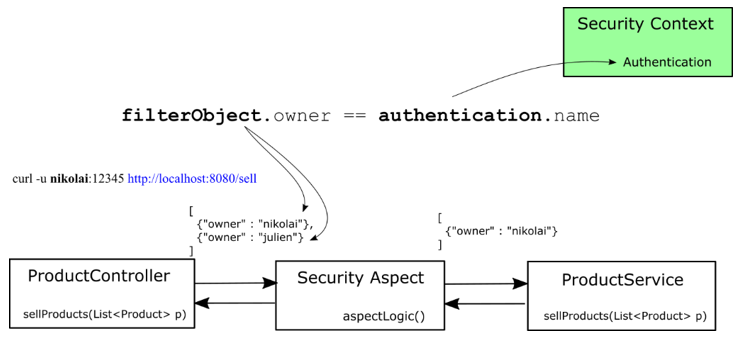
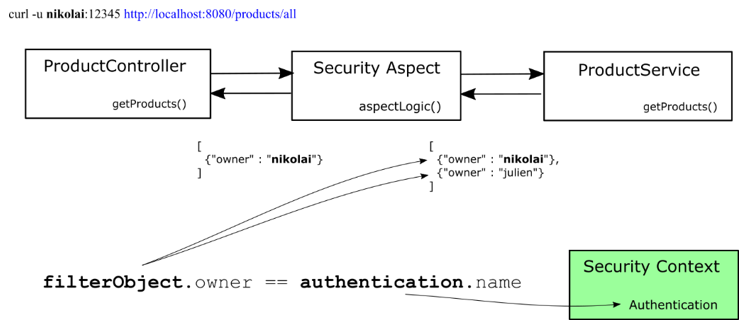
Figure 17.8 In the SpEL expression used for authorization, we use filterObject to refer to the objects in the returned collection, and we use authentication to refer to the Authentication instance from the security context.
Listing 17.7 The ProductService class
@Service
public class ProductService {

  @PostFilter[CA]    #A
   ("filterObject.owner == authentication.name")
  public List<Product> findProducts() {
    List<Product> products = new ArrayList<>();

    products.add(new Product("beer", "nikolai"));
    products.add(new Product("candy", "nikolai"));
    products.add(new Product("chocolate", "julien"));

    return products;
  }
}
#A Adding the filtering condition of the objects in the collection returned by the method.

This is an excerpt from Manning's book Spring Integration in Action.
In all of these cases, the message is a representation of the contract between the sender and receiver. In some applications it might be fine to send a reference to an object over the channel, but in others it might be necessary to use a more interoperable representation like an identifier or a serialized version of the original data.
package org.springframework.integration;

public final class MessageHeaders
    implements Map<String, Object>, Serializable {
   /* implementation omitted */
}
If you can get away with the simple solution of using objects on the heap, go for it. But if it just doesn’t work, look at the filesystem seriously before you jump into even more complex solutions. We look at an example that can best be implemented using file sharing. The rest of the chapter teaches you how you can implement it using Spring Integration’s file support.
Imagine you’re writing new products in a directory for your online shop. These products will be dropped in a directory as XML messages and picked up by a process that inserts them into the database backing your web application. First, the XML must be transformed into a String, and then an unmarshalling step will prepare the objects destined for persistence through a repository. If the transformer deletes the file, it does so after it finishes the transformation, but it’s not unthinkable that subsequent requests are separated by asynchronous handoff. In this case, obviously, the file will be deleted before the objects are persisted, but even if there is no asynchronous handoff, problems can occur because the transaction boundaries are broken. If the process crashes before the file is deleted, but after the inserts are committed, restarting the process might cause duplication.

This is an excerpt from Manning's book Spring Batch in Action.
Transactions in Spring Batch are an important topic: transactions contribute to the robustness of batch processes and work in combination with chunk processing. You configure transactions at different levels because transactions involve several types of objects. In the online store use case, you validate a set of products during processing.
This section on flat files introduced all concepts and types related to the item reader for flat files to import data files as objects. In the next section, we describe the general configuration of a FlatFileItemReader bean in Spring Batch as well as implementations for recordseparator policies and line mappers. We then explain how to handle delimited, fixed-length, and JSON file formats and describe advanced concepts to support records split over several lines and heterogonous records.


This is an excerpt from Manning's book Dependency Injection: Design Patterns Using Spring and Guice.

So now we’ve seen the value of decomposing our services into objects. This principle is important because it highlights the relationship between one object and others it uses to perform a service: An object depends on its services to perform a function.
A class’s constructor is the most straightforward and ready form of lifecycle. It is called after memory has been allocated for the object and used to perform some initialization logic, to put the object into a usable state. Dependency injectors often use constructors to provide objects with their dependencies. This is detailed further in chapter 3.
In Java, when an object is about to be reclaimed by the garbage collector, its finalizer is called. A finalizer is called at an arbitrary, uncontrollable time, in a separate thread. Finalizers may not run until an application shuts down, or not even then! As a result, finalizers are unreliable for performing cleanup of finite system resources such as file handles or network sockets. Finalizers may be useful in rare cases for sanity checks or for reclaiming memory used in native libraries.
Lifecycle and scope are closely related concepts, so much so that they are occasionally confused with each other. An object’s longevity can be seen in these two dimensions. Object longevity with regard to some context (duration, users, threads, and so on) is its scope. Periods in this context indicate various things about an object, for instance, whether it is ready to begin serving clients, or if the object represents a network resource, whether that resource has been closed or abnormally interrupted.
Clearly many of these states are specific to the nature of the object. A movie may have a paused state in its life; a web application has a deployed state, a game has a game-over state, and so on. The various states an object goes through in its life are collectively known as its lifecycle. When an object transitions between such states, it is said to undergo lifecycle changes. These are often modeled as events that an object responds to (see figure 7.1).
public interface InvocationHandler {
    Object invoke(Object proxy, Method method, Object[] args);
}