concept place in category spring

This is an excerpt from Manning's book Spring Microservices in Action.
The core operational patterns that need to be in place to support microservice applications, particularly a cloud-based application
Once the correlation ID was present, you used a custom Spring HTTP filter on every one of your services to map the incoming variable to a custom UserContext object. With the UserContext object in place, you could now manually add the correlation ID to any of your log statements by making sure you appended the correlation ID to the log statement, or, with a little work, add the correlation ID directly to Spring’s Mapped Diagnostic Context (MDC). You also wrote a Spring Interceptor that would ensure that all HTTP calls from a service would propagate the correlation ID by adding the correlation ID to the HTTP headers on any outbound calls.
Oh, and you had to perform Spring and Hystrix magic to make sure the thread context of the parent thread holding the correlation ID was properly propagated to Hystrix. Wow—in the end this was a lot of infrastructure that was put in place for something that you hope will only be looked at when a problem occurs (using a correlation ID to trace what’s going on with a transaction).

This is an excerpt from Manning's book Spring Integration in Action.
We should also mention that both the core Spring Framework scheduling support and the Spring Integration polling triggers accept cron expressions in place of the interval-based values. If you only want to poll during regular business hours, something like the following would do the trick:
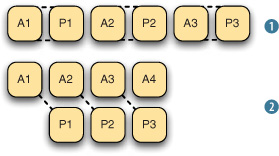
Figure 15.3 captures the differences between the two strategies. Note how fixed-delay polling causes the timing of the polling event to drift over time, but fixed-rate polling takes place at predictable moments.
An enterprise integration application is an assembly of message processing endpoints connected by channels. A message sent to a channel undergoes a series of transformations while it travels through this structure. From a purely logical standpoint, you can start by ignoring whether this series of transformations happens within the scope of a single thread or spans multiple thread contexts; the processing that takes place within each individual endpoint and the end result will be the same. In fact, Spring Integration applications may work just fine by adopting a single-threaded approach, which is also the default. Without any additional configuration options, processing a message from end to end takes place within the scope of a single thread.
 is single-threaded. Scenario
 is concurrent: the assembly and paint take place in parallel, which increases the processing speed.