concept response in category spring
This is an excerpt from Manning's book Spring Microservices in Action, 2E.
What’s impressive about the Spring framework and a testament to its development community is its ability to stay relevant and reinvent itself. The Spring development team quickly saw that many development teams were moving away from monolithic applications where the application’s presentation, business, and data access logic were packaged together and deployed as a single artifact. Instead, teams were moving to highly distributed models where services were being built as small, distributed services that could be quickly deployed to the cloud. In response to this shift, the Spring development team launched two projects: Spring Boot and Spring Cloud.
In this section, I will show you how to implement Spring HATEOAS in the license service. The first thing we must do to send the links related to a resource in the response is adding the HATEOAS dependency into the pom.xml
file. Please add the following dependency to your pom.xml
            <dependency>
                   <groupId>org.springframework.boot</groupId>
                   <artifactId>spring-boot-starter-hateoas</artifactId>
          </dependency>
Once we have the dependency now, we have to update the License
class in order to extend from RepresentationModel<License>
as shown in code Listing 3.12.
Spring Cloud Gateway is the API Gateway implementation by Spring Cloud Built on Spring Framework 5, Project Reactor and Spring Boot 2.0. This gateway is a non-blocking gateway. What means non-blocking? Remember, non-blocking applications are written in a way main threads are never blocked; instead, they are always available to serve requests and to process them asynchronously in the background to return the response once is done processing.
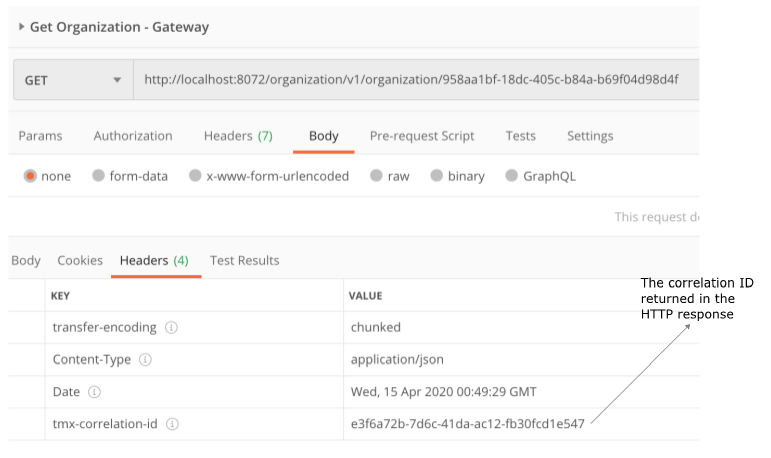
Figure 8.13 The tmx-correlation-id has been added to the response headers sent back to the service client.

This is an excerpt from Manning's book Spring Security in Action.
In this example, the responses A and B are different results of calling the same authentication endpoint. They don’t seem to expose any information related to the class design or system infrastructure, but they hide another problem. If the messages disclose context information, then they can as well hide vulnerabilities. The different messages based on different inputs provided to the endpoint can be used to understand the context of execution. In this case, they could be used to know when a username is correct, and only the password is wrong. And this can make the system more liable to a brute force attack. The response provided back to the client shouldn’t help in identifying a possible guess of a specific input. In this case, it should have better provided in both situations the same message:
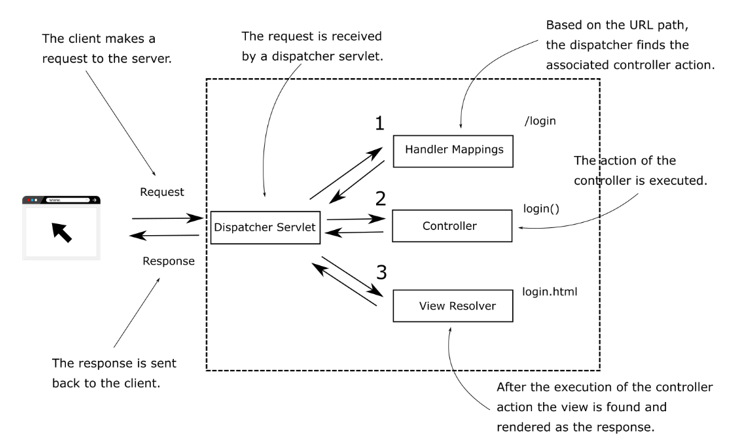
Figure 1.11 A minimal representation of the Spring MVC flow. The Dispatcher Servlet finds the mapping of the requested path to the controller method (1), executes the controller method (2), and obtains the rendered view (3). The HTTP response is then delivered back to the requester, whereby the browser interprets and displays the response.

Listing 5.16 Configuring the realm name for the response of the failed authentication
@Override
protected void configure(HttpSecurity http) throws Exception {
  http.httpBasic(c -> {
    c.realmName("OTHER");
  });

  http.authorizeRequests().anyRequest().authenticated();
}
Listing 5.16 presents an example of changing the realm name. The lambda expression used is, in fact, an object of type Customizer<HttpBasicConfigurer<HttpSecurity>>. The parameter of type HttpBasicConfigurer<HttpSecurity> allows us to call the realmName() method to change the name of the realm. You can use curl with the -v flag to get a verbose HTTP response in which the realm name was indeed changed. However, note that you’ll find the WWW-Authenticate header in the response only when the HTTP response status is 401 Unauthorized and not when the HTTP response status is 200 OK.
curl -v http://localhost:8080/helloThe response of the call is:
/
…
< WWW-Authenticate: Basic realm="OTHER"
…
Also, by using a Customizer, we can customize the response for a failed authentication. You will need to do this if the client of your system expects something specific in the response for the case of a failed authentication. Maybe you’ll need to add or remove one or more headers. Or you could have some logic that filters the body to make sure that the application doesn’t expose any sensitive data to the client.