concept this feature in category spring

This is an excerpt from Manning's book Spring Batch in Action.
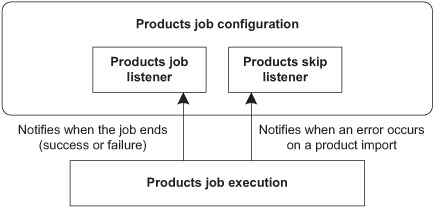
Spring Batch provides the ability to specify and use listeners at the job and step levels within batches. This feature is particularly useful and powerful because Spring Batch can notify each level of batch processing, where you can plug in additional processing. For example, in the online store case study, you can add a listener that Spring Batch calls when a batch fails, or you can use a listener to record which products Spring Batch skips because of errors, as shown in figure 3.7.
We provide concrete examples of this feature in chapter 8. Table 3.10 describes the listener types provided by Spring Batch.

This is an excerpt from Manning's book Spring Dynamic Modules in Action.
OSGi supports this mechanism on both packages and bundles with the Import-Package and Require-Bundle headers. This feature is particularly useful for frameworks and libraries that have associated tooling. When you’re not using the tooling, the tool components don’t need to be present in the OSGi container for the components to be used.
Table 2.4. Standard attributes usable with the Import-Package header
Attribute
Description
version Specifies the version range for matching exported packages. If this attribute isn’t specified, the default value is [0.0.0, ∞). For more details, see section 2.2.5. bundle-symbolic-name Specifies the symbolic name of the component that exports the packages. In the case of a fragment bundle, the name will correspond to the host bundle’s symbolic name instead. A fragment is a special bundle that allows extending an existing bundle. We’ll describe this feature of OSGi in section 3.3. bundle-version Specifies the version of the component that exports the packages. As with version, the default value is [0.0.0, ∞) and the fragment behavior is as for bundle-symbolic-name.