concept type in category spring

This is an excerpt from Manning's book Spring Security in Action.
We classify data as “at rest” or “in transition.” In this context, data at rest refers to data in computer storage or, in other words, persisted data. Data in transition applies to all the data that’s exchanged from one point to another. Different security measures should, therefore, be enforced, depending on the type of data.
12.3.3 Implementing the client credentials grant type
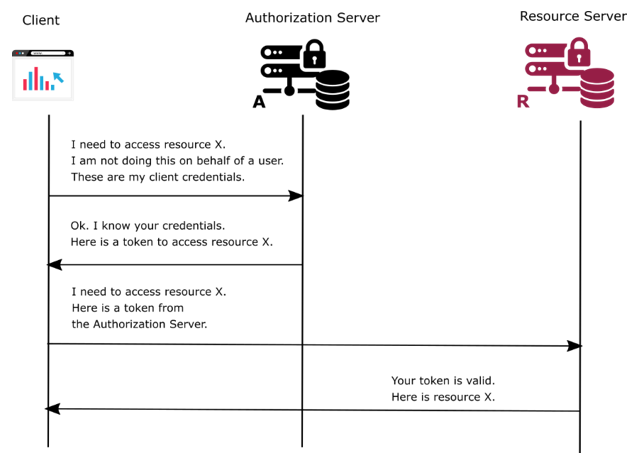
In this section, we discuss the client credentials grant type (figure 12.8). This is the simplest of the grant types described by OAuth 2. You use it when no user is involved – that is when implementing authentication between two applications. I like to think about the client credentials grant type being a combination between the password grant type and an API key authentication flow.
Figure 12.8 The client credentials grant type. We use this flow if a client needs to access a resource, but not on behalf of a resource owner. This resource can be an endpoint that isn’t owned by a user.
Listing 13.10 The client registration for the client credentials grant type
@Configuration
@EnableAuthorizationServer
public class AuthServerConfig
  extends AuthorizationServerConfigurerAdapter {

  // Omitted code

  @Override
  public void configure(
    ClientDetailsServiceConfigurer clients)
        throws Exception {

    clients.inMemory()
              .withClient("client")
              .secret("secret")
              .authorizedGrantTypes("client_credentials")
              .scopes("info");
  }

}

This is an excerpt from Manning's book Spring Integration in Action.
We live in an event-driven world. Throughout each day, we’re continuously bombarded by phone calls, emails, and instant messages. As if we’re not distracted enough by all of this, we also subscribe to RSS feeds and sign up for Twitter accounts and other social media sites that add to the overall event noise. In fact, technological progress seems to drive a steady increase in the number and types of events we’re expected to handle. In today’s world of hyperconnectivity, it’s a wonder we can ever focus and get any real work done. What saves us from such event-driven paralysis is that we can respond to most events and messages at our convenience. Like a return address on an envelope, events usually carry enough information for us to know how and where to respond.
A few different kinds of adaptation are required depending on the type of channel and the role of the handler component being connected to that channel. If the channel is subscribable, the handler is invoked within the thread of the sender or by the channel’s TaskExecutor if one is configured. For such a channel, no polling is required. If on the other hand the channel is one that buffers messages in a queue, such as a QueueChannel, polling is necessary.

This is an excerpt from Manning's book Dependency Injection: Design Patterns Using Spring and Guice.
Still other languages place different (and sometimes fewer) restrictions on types and expressions, allowing objects to take on a more dynamic role in constructing and using services. Python and Ruby are good examples of such duck-typed languages. Neither Python nor Ruby programs need to be compiled; their source code is directly interpreted, and type checking is done on the fly. Copland is a DI library for Ruby that was inspired by (and is analogous to) Apache HiveMind for Java. Copland uses many of the same terms and principles as HiveMind but is more flexible in certain regards because of the dynamic nature of Ruby.
Types are specific classes of data in a programming language. For example, the number 32 is of an Integer type. Types may also be user defined, such as Car or Song. Before operations on data can occur, the data’s particular type must be determined. This is known as type resolution. A dynamically typed language resolves types when an operation is performed, whereas a statically typed language resolves types when an operation is defined (typically, but not necessarily, at compile time).
We have seen how services are identified by a type. Recall some of the examples I’ve used so far in this book: