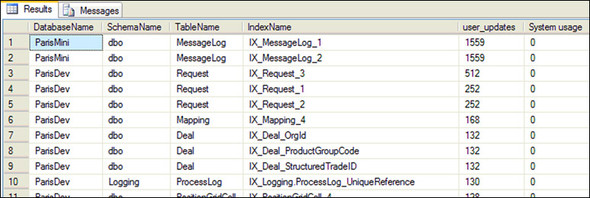
concept most - costly unused index in category sql

This is an excerpt from Manning's book SQL Server DMVs in Action: Better Queries with Dynamic Management Views.
Remember, here we’re explaining the pattern, not the specifics. The details will be explained later in the appropriate DMV section, for example, in examining the most-costly unused indexes (section 3.3.1).
Here you can see that a single DMV and two system tables are involved in identifying the most-costly unused indexes; a brief description of each is shown in table 3.4.
Table 3.4. DMV/system tables to identify the most-costly unused indexes
DMV/tables
Description
sys.dm_db_index_usage_stats Contains details of the different types of index operations, for example, number of updates by user queries sys.indexes Contains details for each index, for example, name and type sys.objects Contains details for each object, for example, schema name By joining the DMV and two system tables, we have enough information to identify the most-costly unused indexes across all the databases on the server. The DMV and the sys.indexes system table are joined on their common key columns: object_id and index_id. The system tables sys.objects and sys.indexes are joined on the object_id key. The system table sys.objects is used to provide information about the schema the index relates to.