concept number in category storm

This is an excerpt from Manning's book Storm Applied: Strategies for real-time event processing.
For our queuing system, we could choose from a number of technologies, including Kafka, Kestrel, and RabbitMQ. The same thing goes for our database choice: Redis, Cassandra, Riak, and MySQL only scratch the surface in terms of options. And look at that—we’ve even managed to include a Hadoop cluster in our solution for performing the required batch computation for our “Top Daily Topics” report.
With the terminology defined, let’s get started with the first of our “common solution” recipes in our cookbook approach, changing the number of worker processes (JVMs) running on a worker node. Addressing these “common solution” recipes now will provide a nice reference for later and allow us to focus on why each is a good solution for a particular scenario.
For increasing the number of available ports, you’ll need to edit the /etc/security/limits.conf file on most Linux distributions. You can add lines such as the following:
* soft nofile 128000
* hard nofile 25600
These settings will set the hard and soft limit on open files per user. The value we’re concerned with as a Storm user is the soft limit. We don’t advise going higher than 128k. If you do, then as a rule of thumb (until you learn more about soft/hard limits for number of files open on Linux), we suggest setting the hard limit to two times the value of the soft limit. Note that you need super-user access to change limits.conf and you’re going to need to reboot the system to make sure they take effect.
Increasing the number of worker nodes in the cluster will give you access to more ports. If you don’t have the resources to add more physical machines or VMs, you’ll have to try the first solution.
Decreasing the number of worker processes in use by existing topologies
This is the quickest and easiest way to free up slots for other topologies in your cluster. But this may or may not be possible depending on the SLAs for your existing topologies. If you can reduce the number of worker processes being used by a topology without violating the SLA, we recommend this approach.
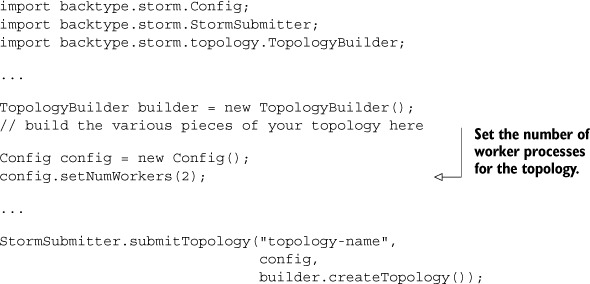
The number of worker processes a topology requests is specified in the code for building and submitting your topology to the Storm cluster. The next listing shows this code.
If your SLAs don’t allow you to reduce the number of slots being used by any of the topologies in your cluster, you’ll have to add new worker processes to the cluster.