concept storm cluster in category storm

This is an excerpt from Manning's book Storm Applied: Strategies for real-time event processing.
So what are executors and tasks? Truly understanding the answer to this question requires deeper knowledge of a Storm cluster and its various parts. Although we won’t learn any details about a Storm cluster until chapter 5, we can provide you with a sneak peek into certain parts of a Storm cluster that’ll help you understand what executors and tasks are for the purpose of scaling our topology.
So far, we know that our spouts and bolts are each running as one or more instances. Each of these instances is running somewhere, right? There has to be some machine (physical or virtual) that’s actually executing our components. We’ll call this machine a worker node, and though a worker node isn’t the only type of node running on a Storm cluster, it is the node that executes the logic in our spouts and bolts. And because Storm runs on the JVM, each of these worker nodes is executing our spouts and bolts on a JVM. Figure 3.12 shows what we have so far.
Running our topologies locally and simulating a Storm cluster within a single process has served our needs so far and is useful for development and testing purposes. But local mode doesn’t support the scaling discussed in chapter 3 nor the first-class guaranteed processing we learned about in chapter 4. An actual Storm cluster is needed for both of these.
This chapter will begin by explaining the parts of a Storm cluster and the roles they play, followed by a Q&A session on how Storm provides fault tolerance. We’ll then move on to installing a Storm cluster and deploying and running your topologies against the installed cluster. We’ll also cover an important tool you can use to make sure your topology is healthy: the Storm UI. Along the way, we’ll provide a preview into the tuning and troubleshooting topics that will be covered in chapters 6 and 7.
It all starts with the Storm cluster, so let’s expand on our worker nodes discussion from chapter 3.
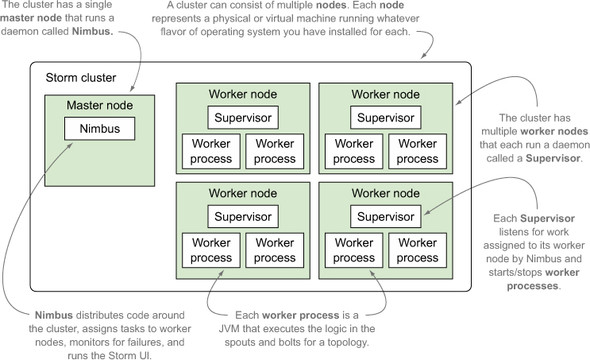
Chapter 3 scratched the surface of a worker node and how it runs a JVM, which in turn runs executors and tasks. In this section, we’re going to go much deeper, starting with the Storm cluster as a whole. A Storm cluster consists of two types of nodes: the master node and the worker nodes. A master node runs a daemon called Nimbus, and the worker nodes each run a daemon called a Supervisor. Figure 5.1 shows a Storm cluster with one master node and four worker nodes. Storm supports only a single master node, whereas it’s likely your cluster will have a different number of worker nodes based on your needs (we’ll cover how to determine this number in chapters 6 and 7).
We’re finally at a point to discuss the last piece, a fault-tolerant Storm cluster infrastructure. The components of a Storm cluster have been designed with fault tolerance in mind. The easiest way to explain how Storm handles fault tolerance is to answer questions in the form of “What does Storm do when x happens?” The most important questions on fault tolerance are addressed in table 5.1.