concept streaming system in category streaming

This is an excerpt from Manning's book Grokking Streaming Systems.
Streaming systems are the computer systems that process continuous event streams. Let’s look at two examples.
You have read about why and what of streaming at the surface level. As we are sure you can guess, there are many moving parts to streaming systems. Getting started in any new technology can be overwhelming on understanding where to start. This book will walk you through learning streaming systems in a way to build your knowledge incrementally chapter by chapter. Each chapter will increase complexity of learning as you go, but will keep the introduction to new concepts to allow you to digest and understand them without causing a mental overload. The hope is to keep the flood of new concepts at one time down to a minimum so you can focus on learning the material well.
Before moving forward to solve the problem with a streaming system, it could be helpful to learn the five key concepts, Event, Job, Source, Operator and Stream, with more details. Keep in mind that these concepts will apply to most streaming systems with a one to one mapping.
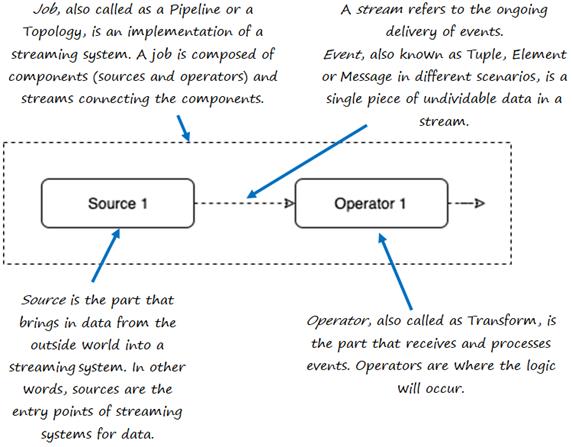
We will cover how the concepts are used in a streaming system as we walk through the different parts of your first streaming job.

This is an excerpt from Manning's book Streaming Data: Understanding the real-time pipeline.
In the request/response optional patterns a client external to the streaming system is pushing the message to it. In our previous examples this was a web browser, a car, or a phone—all clients that send a message to our collection tier. In the case of the stream pattern, our collection tier connects to a stream source and pulls data in. For example, you may be interested in building a streaming system to do sentiment analysis of tweets. To do so, you’d build a collection tier that establishes a connection to Twitter and consumes the stream of tweets.
As you know from previous chapters, one of the unique aspects of a streaming system is that we can’t store the entire stream because it’s unbounded and never-ending. Our goal is to continually provide results to queries online. As data reaches the analysis tier, the results must be recomputed or updated and potentially emitted. On the surface, answering these types of queries may seem easy, but when you consider or design algorithms that will process a stream, it is important to take into consideration the following constraints:
If you’ve worked with a data system where the data is static, such as Hadoop or an RDBMS, you probably thought about time as you were executing queries. In a static world you execute your MapReduce job, Spark job, Hive query, SQL query, or in some other fashion query the data set and perhaps provide a time range in the where clause, and you know the resulting data is all the data that is loaded within a given time range. In contrast, with a streaming system, along with our constraints, the data is constantly flowing. It may be out of order when we see it or delayed—and we can’t query all the data at once, because the stream never ends. Don’t worry—all is not lost. I’ll discuss concepts and approaches to thinking about time and solving common problems when analyzing a stream of data.