concept another service in category system administration

This is an excerpt from Manning's book Tuscany SCA in Action.
In the following sections we’ll use this Payment callback example to explore various aspects of the callback programming model that are specific to Java implementations. We’ll show how callbacks are declared using bidirectional interfaces, and we’ll review how bidirectional services obtain callback proxies by injection. We’ll look at how bidirectional services can obtain callback proxies using API calls instead of by injection, and we’ll demonstrate how bidirectional services can use callable references to provide more flexibility in making the callback. We’ll also show how clients can identify and correlate individual callbacks using callback IDs. Finally, we’ll look at how clients can delegate callback handling to another service.
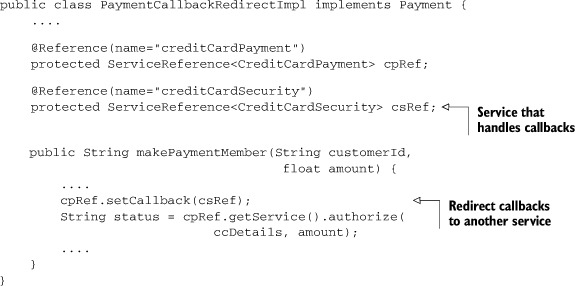
A client implementation that calls a bidirectional service can choose not to handle callbacks itself, but redirect callbacks to another service instead. To do this, the client implementation obtains a ServiceReference object for the bidirectional service and calls the setCallback() method on this ServiceReference object, passing another ServiceReference object identifying a service that will handle callbacks from the bidirectional service. The following code is a modification of the code in listing 5.6, showing an example of this.