concept class in category system administration

This is an excerpt from Manning's book Open Source SOA.
We’ve frequently pointed out that one of the major benefits of using SCA is that you can create services in a protocol-neutral fashion, with the selected binding defined declaratively at runtime. The same benefits also apply to references, whereby the class receiving the referenced object is oblivious to what communications protocol is being used (the referenced object’s interface must be defined, but not the implementation details). Thus, the recipient component couldn’t care less whether the injected class arrives via SOAP, JMS, or EJB.
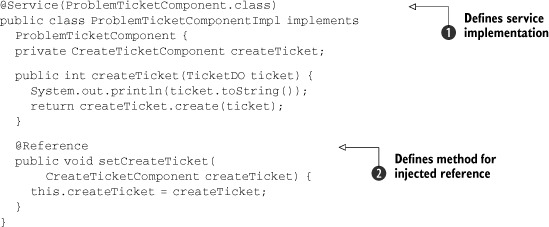
The concrete implementation for this component is performed by the class ProblemTicketComponentImpl. Let’s create this class (listing 3.3) so we can illustrate what has to be done to provide the SCA component functionality (we’ve purposely kept our example simple to begin with).
As you can see, there are two SCA annotations specified in the class
,
. The @Service annotation