concept concept in category system administration

This is an excerpt from Manning's book Securing DevOps.
Securing DevOps is about helping organizations operate securely and protect the data their customers entrust them with. I introduce a model I refer to as “continuous security,” which focuses on integrating strong security principles into the various components of a DevOps strategy. I explain culture, architectural principles, techniques, and risk management with the goal of going from no security to a mature program. This book is primarily about principles and concepts, but throughout the chapters we’ll use specific tools and environments as examples.
DevOps can mean many different things, depending on which part of information technology (IT) it’s being applied to. Operating the infrastructure of a nuclear plant is very different from processing credit card payments on websites, yet both equally benefit from DevOps to optimize and strengthen their operations. I couldn’t possibly cover all of DevOps and IT in a single book, and decided to focus on cloud services, an area of IT dedicated to the development and operations of web applications. Throughout the book, I invite the reader to develop, operate, secure, and defend a web application hosted in the cloud. The concepts and examples I present best apply to cloud services, in organizations that don’t yet have a dedicated security team, yet an open-minded reader could easily transfer them into any DevOps environment.
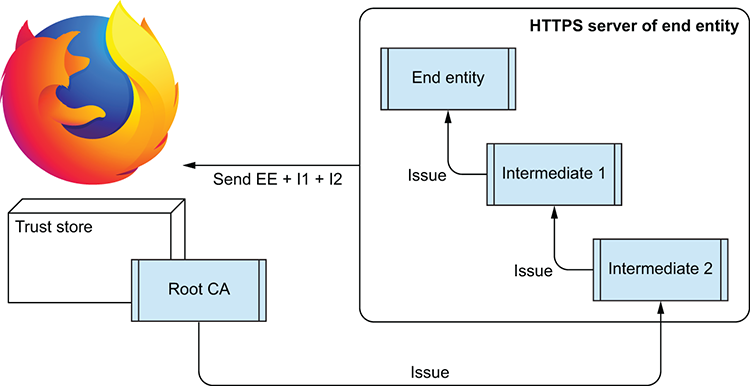
The PKI works by first trusting a set of authorities, or more specifically trusting their public keys. In web browsers, you encounter those authorities under the name certificates authorities (CA) that are kept in root stores, or trust stores. The concept of the PKI is simple: the public key of Bob must be cryptographically signed by the private key of a CA you trust to be considered valid. When Bob sends you his public key, he also sends you the signature of his public key performed by the CA. By verifying the signature using the CA’s public key, which you trust, you obtain the assurance that Bob’s key is trustworthy and not replaced by some man in the middle. The CA must make sure to only sign keys that belong to the right people, but that’s their job, not yours. In concept, this is identical to Alice’s passport being signed (or rather, issued) by a trusted government that first verified her identity: because we trust the authority keys in the PKI, we carry that trust to keys signed by them.
Figure 5.3 High-level view of the concept of chain of trust applied to verifying the authenticity of a website. The Root CA in the Firefox trust store provides the initial trust to verify the entire chain and trust the end-entity certificate.