concept context in category system administration

This is an excerpt from Manning's book Operations Anti-Patterns DevOps Solutions.
Error rates and error counts are quite different. Error counts are a metric that most engineers are familiar with. It tallies the number of errors that have happened since a process or system has started. In every system there is some unit of work, like a web request. That unit of work is either going to be deemed successful or failed based on criteria inside your application. An error count would be a simple tally of the number of failed units of work your system has encountered. Error rates are a calculation on error count and are represented as a percentage of the total number of requests. To calculate the error rate, you would take the number of failed work units and divide it by the total number of work units. For example, if your work unit is web hits and you received 100 hits, that would be your total number of work units. If 10 of those web hits resulted in failed requests, your error rate would be 10%. (10 divided by 100) Error rates are more useful than error counts because they give context for people who may not be as familiar with the system. 500 errors per minute sounds like a lot until you realize the total number of hits in that sample period is 100,000. The number 500 can be alarming to people not familiar with normal operating volumes. But 0.005% conveys the scope of the errors in relation to total traffic volume. It also can make alerting easier as traffic volumes fluctuate.
Sometimes with a system you might have so much data that you’re not really sure what’s going to be useful in a support type of situation. Instead of starting with a question of “What do I want to know?” people start from the perspective of “What answers do I have?” This leads to a few problems. First, you don’t challenge yourself to come up with ways to get the answers to the questions you have. And secondly, you tend to think of the data you have as the final answer or response. But data and information are two very different things. Data is just raw unorganized facts but when you take that data, give it context and structure it becomes information. When you’re looking at a dashboard you can quickly tell what dashboards are giving you data and which dashboards are giving you information.
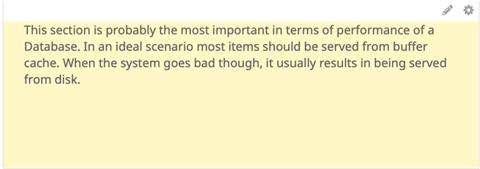
Figure 4.7 gives an example of a note, to add context to a widget.

This is an excerpt from Manning's book Functional and Reactive Domain Modeling.
Eric Evans calls this the ubiquitous language. Use the domain vocabulary in your model and make the terms interact in such a way that it resembles the language that the domain speaks. Start with the correct naming of entities and atomic behaviors, and extend this vocabulary to larger abstractions that you compose out of them. Different modules can speak different dialects of the language, and the same term may mean something different in a different bounded context. But within the context, the vocabulary should be clear and unambiguous.
Having a consistent ubiquitous language has a lot to do with designing proper APIs of your model. The APIs must be expressive so that a person who’s an expert in the domain can understand the context by looking at the API only. This is known as domain-specific language; see my book DSLs in Action (Manning, 2010) for a detailed treatment of the subject.
A functor gives you the capability to lift a pure function of one argument into a specific context. Look at the definition of map in the trait Functor. The pure function f: A => B is lifted into the context of F, transforming F[A] to F[B]. The context here is the type constructor F, also known as the effect of the computation. But what happens when you have a function of two arguments that you’d like to lift into a context? Or you can even generalize and think of functions of any arity to be lifted into some context. The Applicative Functor design pattern is a solution to this generic problem.
The function foldMap does exactly what I said before: folds over a collection F[A], where f: A => B generates a monoid B out of A. And f can be an identity if A is a monoid. So, given a Foldable[A], a type B that’s a monoid, and a mapping function between A and B, you can package foldMap nicely into a combinator that abstracts your requirements of maxDebitOnDay and sumBalances (and many other similar domain behaviors) without sacrificing the holy grail of parametricity. And this is the second step toward making your model more generic using design patterns: You’ve abstracted over the context, the type constructor of your abstraction.

This is an excerpt from Manning's book Open Source SOA.
The Esper project (whose name was derived from ESP-er, someone born with telepathy or paranormal mental abilities) was first released in August 2006. However, the project founder, Thomas Bernhardt, had developed earlier prototypes of ESP type solutions while working at a large financial institution. Since its initial release, a steady stream of updates has been provided (the most recent release, as of this writing, was 3.0). Beyond typical bug fixes, the main focus of enhancements relate to the Event Query Language (EQL), which is an SQL-like language for developing query expressions against inbound events. With EQL, you register prebuilt queries into the ESP engine, and as data is received, it’s evaluated against those queries. Because events often must be viewed within the context of time (that is, no order in 15 minutes at night may be normal, but during the day, may indicate a website outage, for example), EQL provides “temporal window” syntax that allows time-period queries to be defined.
Before we get into the features and capabilities, let’s first examine the lifecycle of how a jBPM process is typically developed and deployed, as this will provide context for our technical discussion later.
public class MessageActionHandlerField implements ActionHandler {

  String message;
  Element xml; //org.dom4j.Element;
  Map<String, String> map;
  public void execute(ExecutionContext context) throws Exception {

   context.getContextInstance().setVariable("message", message);

   System.out.println("map is: " + map.size());
   System.out.println("xml is: " + xml.asXML());
  }
}

This is an excerpt from Manning's book SOA Security.
In this opening chapter, we will briefly review traditional approaches to security and evaluate them in the context of changes SOA is expected to bring in IT. We will find that traditional approaches to security don’t work well with SOA. We will identify the specific challenges that need to be solved and suggest new approaches that you can use to solve them.
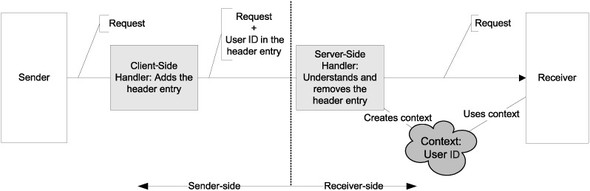
Figure 3.6. Illustration of how handlers can produce and consume the header entries and communicate context to a service. The client-side handler adds the header entry and the server-side handler consumes the header entry. These handlers are actually part of the sender and receiver applications, respectively, and are implemented as libraries. Notice that the SOAP message passed between the applications contains the WS-Security Header element.