concept continuous delivery in category system administration

This is an excerpt from Manning's book Operations Anti-Patterns DevOps Solutions.
In contrast, continuous delivery is a practice aimed to ensure that the application is always in a deployable state. This mean that you no longer have a broken master or trunk branch during a release cycle, regardless of how often you do a release.
The two items often get conflated. The main difference is that with continuous deployment, every change that gets committed to the main branch gets released through an automated process, with no manual intervention. With continuous delivery, the focus is more on ensuring the capability to deploy code when needed without having to wait for a large release train with a bunch of other changes. Every commit may not be released automatically, but it could be released at any time if needed.
For a simple example, imagine a product manager wants to release a small change to fix a problem that a single customer is having. In an environment without continuous delivery, she might need to wait until the next release of the system, which could be weeks away. In a continuous delivery environment, the deployment pipelines, infrastructure and development processes are structured so that a release of an individual piece of the system is possible at any point. The product manager could have development make the change and release that bug fix on a separate timetable than the other development teams.
With those definitions laid out, it should be noted that continuous deployment can’t really happen without continuous delivery. Continuous delivery is a stop on the journey to continuous deployment. Despite the hype around continuous deployment, I personally don’t feel it’s a great goal for all companies. The act of continuous deployment is supposed to force certain behaviors onto the organization. You need rock solid automated testing if you’re going to deploy every commit to production. You need a solid code review process to ensure multiple sets of eyes have looked at code from whatever review criteria your teams have setup. Continuous deployment forces this behavior because without it, disaster might ensue. I believe in all these things. But I also believe that many teams and organizations have a lot of hurdles to overcome before they can realistically begin talking about continuous deployment. When tech teams take weeks to roll out patches for their systems, moving to continuous deployment seems like a pretty big leap. I think the act of continuous delivery is a better goal for most organizations. The goal of deploying every change as it gets committed is a noble one. But so many organizations are so far away from being able to safely and reliably do that. Many of their internal processes are structured around the idea of a deliverable unit called a “release”. But when you’re doing continuous deployment, even the concept of what a release is has to change within the company. How many internal processes are based on software versions? Sprints, project plans, help documentation, training, all these things are often centered around this ritualistic concept of a release. Considering how far the journey is, I think targeting the ability to release more frequently will give tremendous benefits without having to create upheaval within the organization regarding how they view, manage and market their software platform.
But whether you decide on continuous deployment or continuous delivery, the question might come up, how do you know that your code is deployable, if you’re not deploying it on a regular basis? That brings us back to the testing suite that I started this chapter with. Your testing suite will be one of the signals your teams will use to evaluate if a change being made breaks the ability to deploy your application. Continuous delivery focuses on this idea of a series of structured, automated steps that application code goes through to prove its viability for deployment. These steps are called deployment pipelines.

This is an excerpt from Manning's book Securing DevOps.
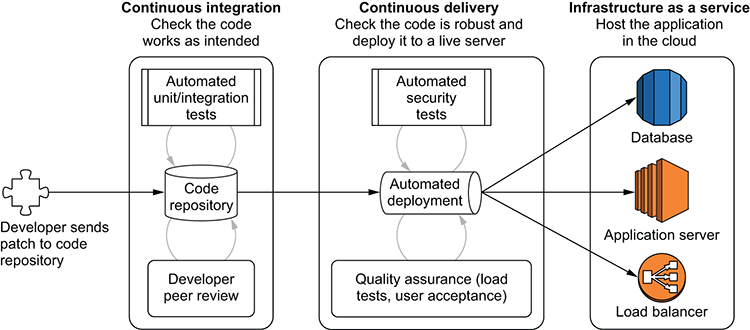
With DevOps, developers can release new versions of their software, test them, and deploy them to customers in as little as a few hours. That doesn’t mean versions are always released that quickly, and it can take time to do proper quality assurance (QA), but DevOps provides the ability to move quickly if needed. Figure 1.2 zooms into the bottom section of figure 1.1 to detail how the techniques of continuous integration, continuous delivery, and infrastructure as a service are used together to achieve fast release cycles.
Figure 1.2 Continuous integration (CI), continuous delivery (CD), and infrastructure as a service (IaaS) form an automated pipeline that allows DevOps to speed up the process of testing and deploying software.